Service Recovery
Part of Complaint journey design
Setting clear expectations for complaint resolution
Tell customers who owns their complaint, when they will hear back and what remains uncertain.
A customer needs to know who is accountable for their complaint, what will happen next and when they will hear from you again. Acknowledging the issue without naming an owner or setting a next update date can leave them unsure whether anything is happening.
Explain the process in plain terms
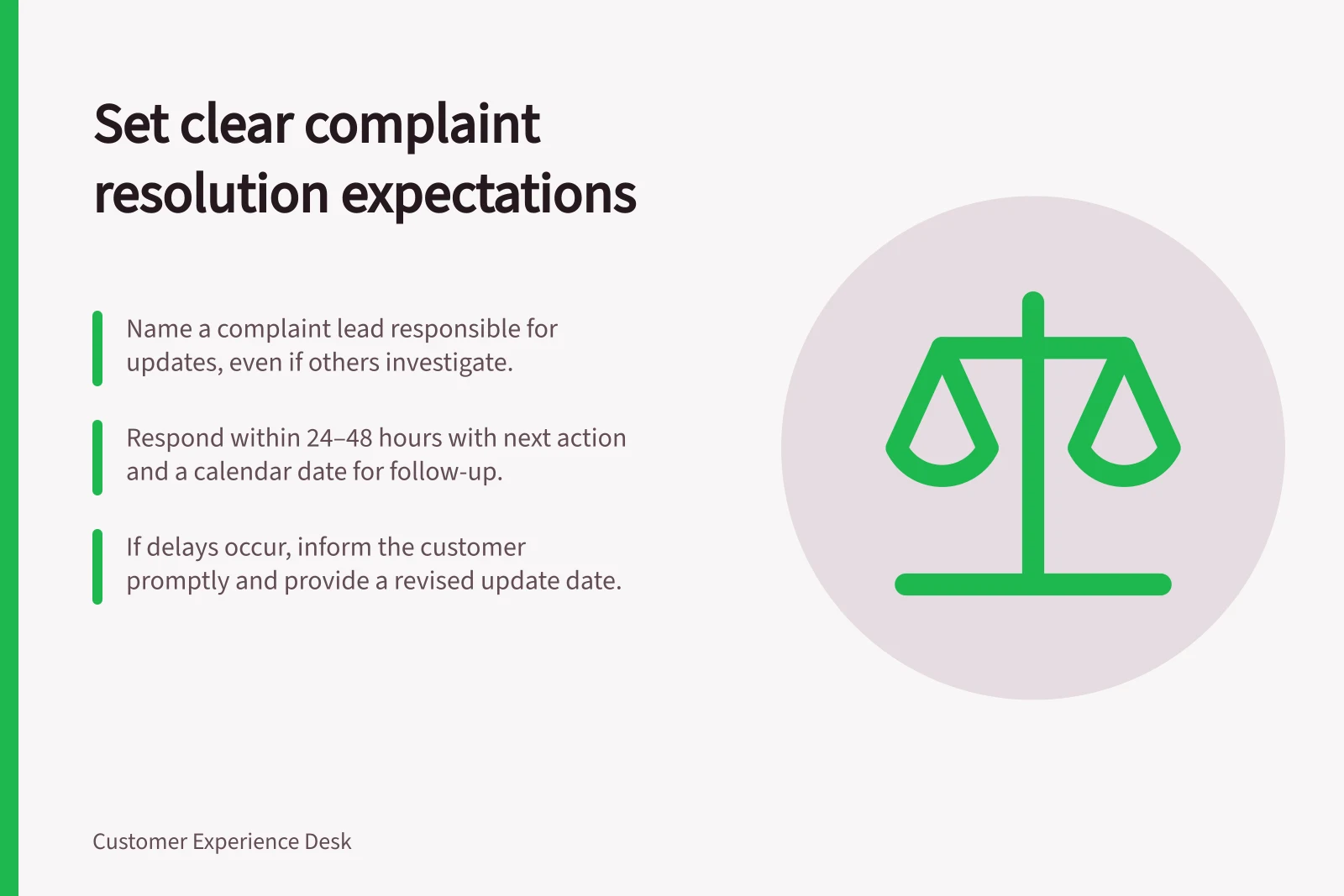
Confirm what you understood, what information you have and what you still need. Name a complaint lead who is accountable for keeping the customer informed, even if a supplier or technical team must investigate.
State the next action and give a calendar date for the next update. Xero’s guide suggests responding to complaints within 24–48 hours; treat that as an internal response target, not a guaranteed resolution time.
Template: We’ve recorded your complaint about [issue]. [Complaint lead or role] is responsible for keeping you updated. We’ll [next action] and contact you again by [date], even if we do not yet have a final answer. We still need [information], and the timing of a resolution depends on [specific dependency].
For a damaged-item complaint, an immediate replacement may be possible once stock and the customer’s address are checked. A disputed service charge may require the team to examine records first, so give these cases different next-update dates rather than one scripted promise.
The business.gov.au guidance Handle customer complaints identifies the Australian Consumer Law as a law businesses must follow. It also says customers can lodge a complaint with their state or territory consumer protection agency; identify the relevant agency if the customer asks what to do next.
Complaint Handling Benchmarks from Australian Sources
- Response time target
- 24–48 hours
- Legal framework
- Australian Consumer Law (ACL)
- Alternative dispute resolution
- State/territory consumer protection agency
Expected Timeline for Complaint Resolution by Issue Type
- Damaged item replacement
- Stock and address check → immediate replacement
- Disputed service charge
- Records review required → delay until investigation complete
Close the expectation gap
If an expected update or remedy date slips, contact the customer promptly, explain why and give a revised date for the next update. Record the new promise, next action and owner so the complaint does not go unnoticed in a queue.
Track overdue updates as well as time to closure; a quick internal status change that leaves the customer uninformed is not a good result. After the problem is solved, business.gov.au recommends following up with the customer.