Service Recovery
Part of Complaint journey design
Closing a complaint with an explanation the customer can use
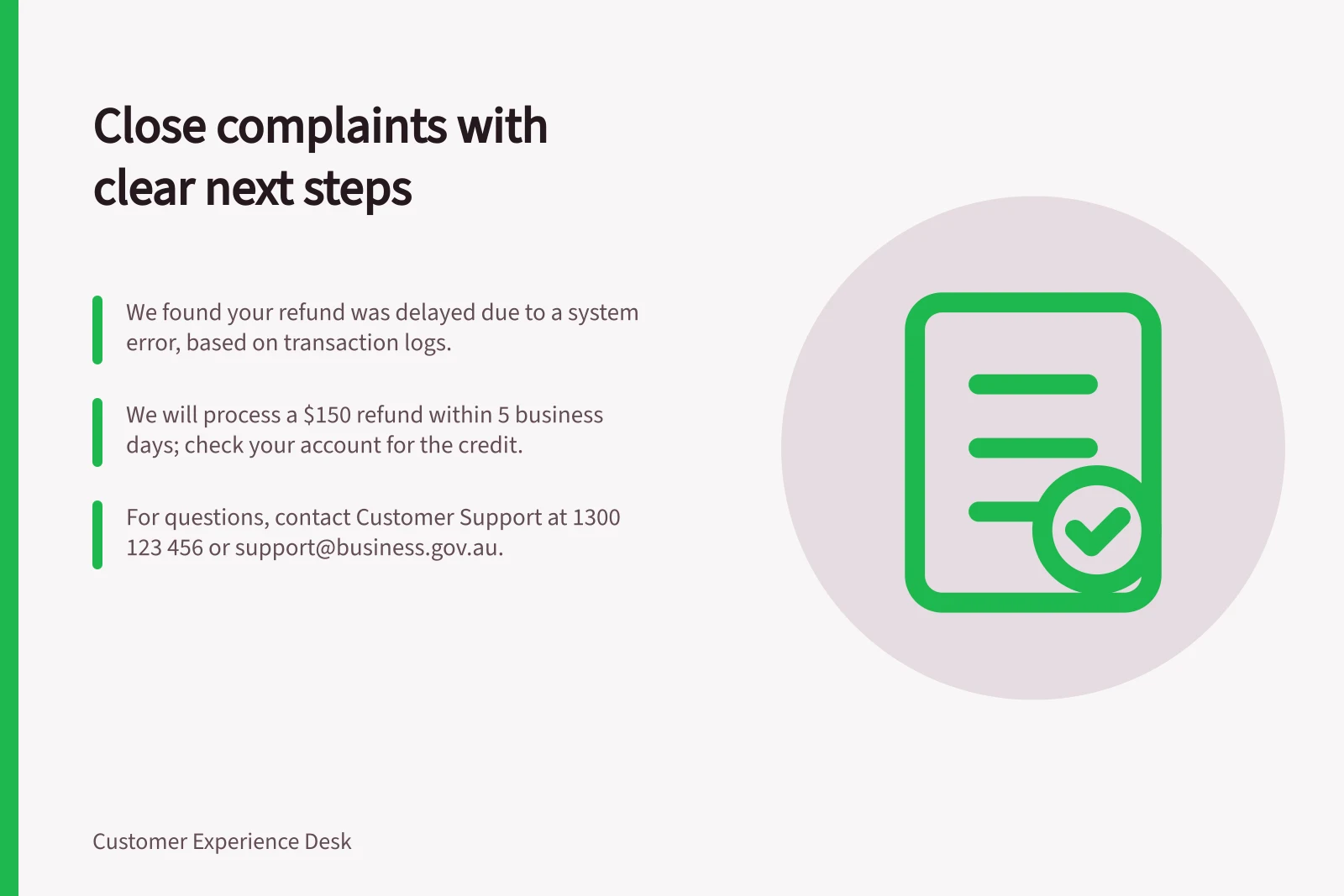
Close a complaint with a clear finding, action, timeframe and route for further review.
A useful complaint outcome tells the customer what you found, what you will do and what they need to do next, if anything. Keep the finding and remedy separate, and use plain language the customer can act on.
State the finding and remedy separately
Summarise the issue in the customer’s terms, then state what the evidence showed without sharing another person’s information. Name the remedy precisely: what will be refunded, replaced, repaired or corrected, and how the customer will know it is done.
Copy and complete with details checked in the case: We found [plain-language finding], based on [relevant evidence]. We will [specific remedy]. You [do/do not] need to [next action]. If a completion date is confirmed, include it.
If you decline the requested outcome, explain why and the basis for the decision: We can’t [requested outcome] because [case-specific reason and basis]. We can [other remedy, if offered].
For a purchase involving goods or services, business.gov.au says the Australian Consumer Law outlines consumers’ rights when buying them. The ACCC provides information about consumer complaints, but does not resolve individual complaints or provide legal advice.
Consumer Rights Under Australian Consumer Law
- Right to a refund
- If the product is faulty, not as described, or unfit for purpose
- Right to repair or replacement
- For goods that are defective or fail to meet consumer guarantees
- Right to compensation
- For services that don’t meet standards or are not completed on time
Give a usable path after the decision
Tell the customer what to do next, if anything, and who to contact with questions or further information. A usable message can say: For questions or to provide more information, contact [named person or team] at [contact details]. Please [customer action, if any].
If the customer remains unhappy, they can lodge a complaint with their state or territory consumer protection agency. business.gov.au names Access Canberra, NSW Fair Trading, Consumer Affairs in the Northern Territory, the Office of Fair Trading in Queensland, SA Government, Consumer, Building and Occupational Services (CBOS) in Tasmania, and Consumer Affairs Victoria.
The ACCC provides information to consumers and businesses and uses reports to inform its education, compliance and enforcement work. It does not resolve individual complaints or give legal advice, so do not present it as the route for resolving an individual case.
Record promises and agreements, then follow up after the problem is solved to check whether the customer is happy and gather feedback; business.gov.au recommends both. Before marking the case closed, verify the promised action—for example, check whether the payment reversed, the parcel dispatched or the account correction appeared.
Where to Escalate If Unhappy
- Access Canberra
- Australian Capital Territory
- NSW Fair Trading
- New South Wales
- NT Consumer Affairs
- Northern Territory
- Office of Fair Trading (QLD)
- Queensland
- SA Government – Consumer Affairs
- South Australia
- Tasmania CBOS
- Tasmania
- Consumer Affairs Victoria
- Victoria
Before Closing the Complaint
- Verify the promised action was completedConfirm refund reversed, parcel dispatched, or account corrected
- Record all agreements and promisesDocument outcomes for compliance and follow-up
- Follow up to check customer satisfactionAsk for feedback after resolution