Journey Mapping
Complaint journey design
Design a complaint journey that customers can find, understand and complete, while turning repeated failures into fixes.
A complaint is a customer trying to get a problem recognised and resolved. The journey starts before a case number exists: they must find a route, explain the issue, know what will happen next and receive a usable outcome.
Make entry and ownership clear
Once a complaint is received, ask for enough information to identify the problem. Do not demand details the business already holds. Australian business guidance recommends making complaints easy and giving staff an understandable procedure.
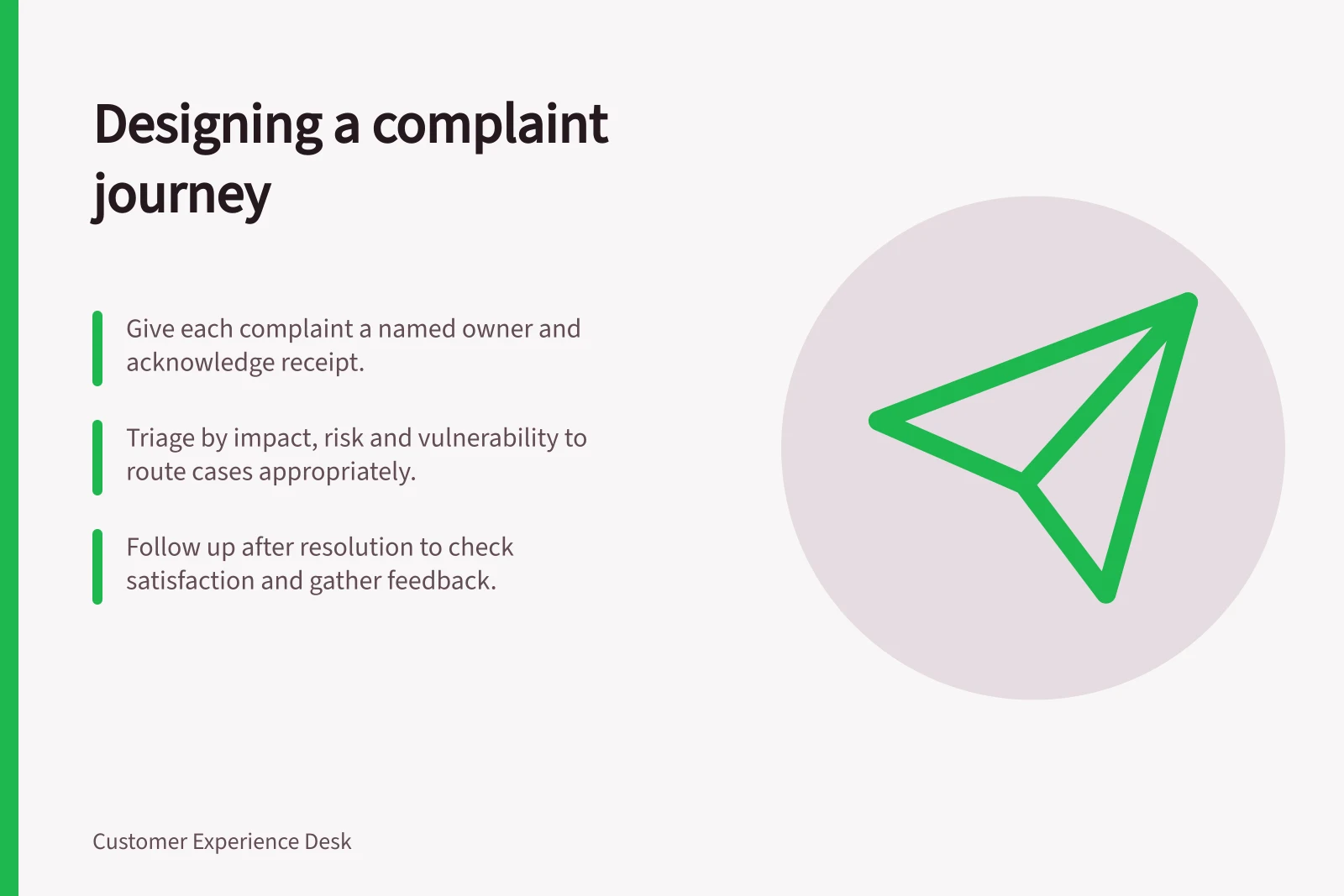
Give each case a named team or owner and acknowledge what was received. Keep ownership visible so the customer knows who is handling the case.
Triage complaints by issue, impact, risk and vulnerability. Route high-impact or regulated cases to senior handlers, and fast-track low-risk, well-defined issues for resolution.
Listen before deciding
Treat the first conversation as fact-finding, not just intake. Listen actively and give the customer room to explain what happened; understanding the complaint in depth helps staff respond to the actual problem rather than an assumption about it.
If the business caused or contributed to the problem, acknowledge the specific error and apologise promptly, pairing the apology with proportionate redress.
Investigate and explain the outcome
Keep the customer’s account, relevant transaction and checks performed in one record.
If a product or service issue may involve Australian Consumer Law rights, assess those rights rather than relying only on a manufacturer warranty or a blanket policy. When determining a remedy, assess the nature of the problem and the consumer guarantee that applies.
Ensure any promised replacement, refund or service correction actually occurs; a “resolved” label in the support tool is not the customer outcome.
Key Facts on Complaint Handling in Australia
- Australian Consumer Law Applies
- Mandates consumer guarantees on goods and services
- Refunds or Replacements Must Be Delivered
- A ‘resolved’ status in systems does not equal customer satisfaction
- Proportionate Redress Required
- If business caused issue, apology must be paired with appropriate remedy
Apply obligations consistently
Make sure the people handling complaints understand the fair trading laws and regulations relevant to the business. Internal procedures should support staff to respond consistently while meeting those obligations, rather than letting different handlers rely on different assumptions.
The Australian Consumer Law is one law businesses must follow. Business procedures should account for obligations that may apply to returns of goods and complaints about services; check the relevant requirements when assessing a case rather than treating a general policy as the answer.
Check in after the case
After the problem has been addressed, follow up with the customer to check whether they are satisfied and invite feedback on the handling process. Use that feedback where possible to improve the service the customer received; a completed case record alone cannot show whether the customer felt heard.
Build a useful case record
Record promises and agreements made during conversations, including any agreed action. A written record helps prevent later disputes or mix-ups about what the business and customer decided.
Ask for documents that may help clarify the issue, such as a receipt or a photo of a faulty item. Request evidence for a clear purpose: it may help staff understand what happened, meet legal or industry-code obligations, improve processes, train staff consistently or support later dispute resolution.
Know the external pathways
A customer may also lodge a complaint with their state or territory consumer protection agency. Relevant agencies include Access Canberra, NSW Fair Trading, the Queensland Office of Fair Trading, Consumer Affairs Victoria and Consumer, Building and Occupational Services in Tasmania.
Businesses can check with their local agency about what to do if a complaint is made against them.
The ACCC provides information to consumers and businesses responding to complaints, and uses reports and other data to inform education, compliance and enforcement work, particularly on issues that may cause widespread harm. It does not resolve individual complaints or provide legal advice, so distinguish its role from handling the customer’s individual case.
Internal vs External Complaint Pathways in Australia
- Business Internal ProcessHandles complaints directly; aims for resolution within policy and law
- State/Territory AgenciesExamples: NSW Fair Trading, Consumer Affairs Victoria, Access Canberra – provide consumer protection and dispute resolution
- ACCC (Australian Competition and Consumer Commission)Monitors systemic issues; informs enforcement and education; does not resolve individual complaints
Learn across cases
This article covers handling one complaint end to end; a sibling article covers identifying repeated failures behind individual complaints.
In this guide
- Making a complaint route easy to findPut complaint routes where customers need them and reduce the information and accessibility barriers to raising an issue.
- Setting clear expectations for complaint resolutionTell customers who owns their complaint, when they will hear back and what remains uncertain.
- Closing a complaint with an explanation the customer can useClose a complaint with a clear finding, action, timeframe and route for further review.