Journey Mapping
Part of Customer experience research
Combining interviews with observed customer behaviour
Plan interviews and task observation around one question, compare what customers say and do, and keep interpretations traceable.
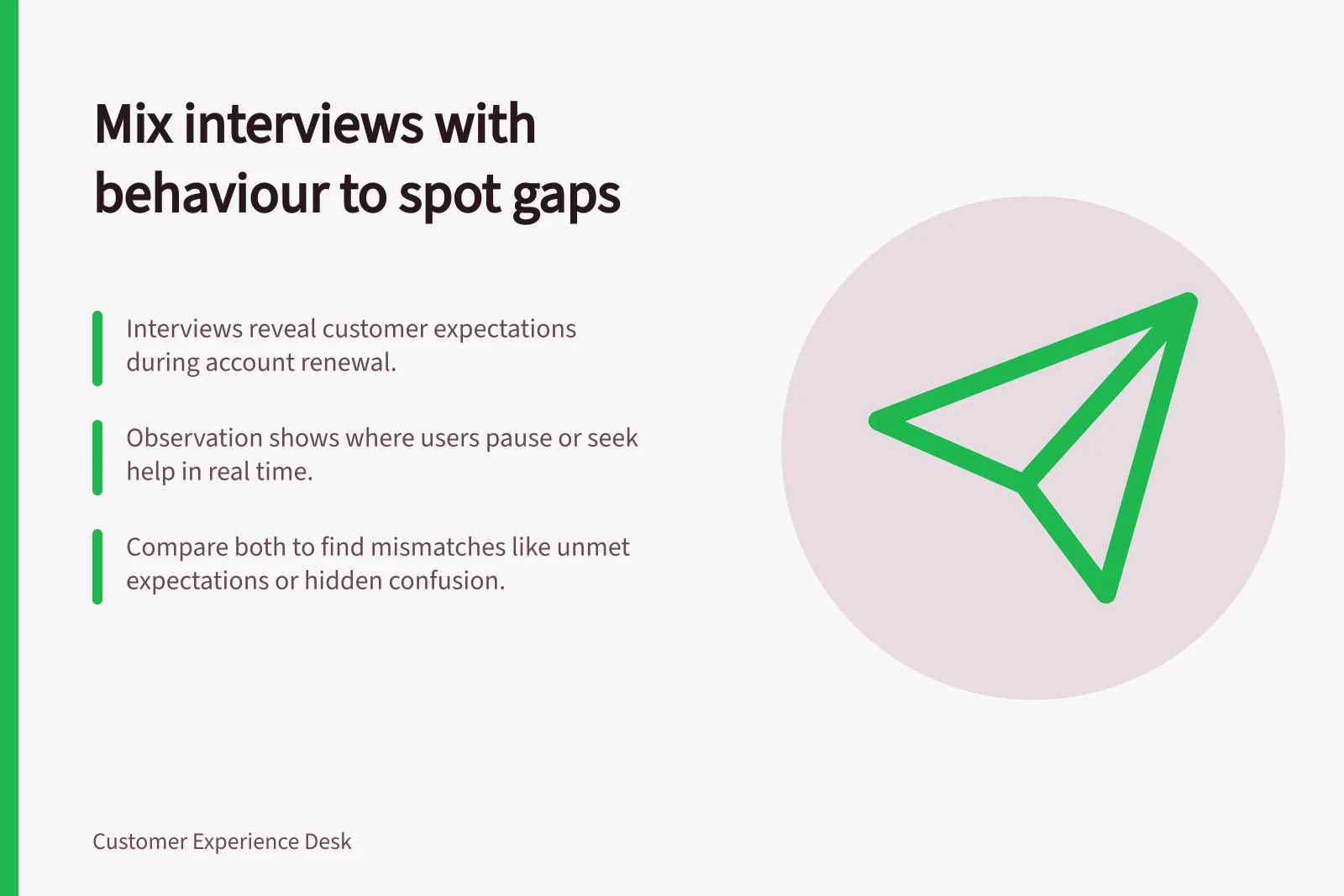
Interviews reveal how customers understood an experience. Observation shows what they did during a relevant task. Use both for one question, then compare the accounts without assuming either is complete: recollection may miss a step, while observation may leave expectations unclear.
Choose one shared task
Suppose customers describe account renewal as straightforward, but the team wants to know why some seek help afterwards. A combined study could ask where renewal leaves people uncertain about what happens next. Recruit people with relevant experience and give them a realistic goal in a safe setting. If the live task changes an account or payment, use an appropriate prototype or test arrangement.
Keep the interview and observation on the same part of the experience. An interview about renewal and an observed attempt at an unrelated task give little basis for comparison.
Ask, observe, then follow up
Before the task, ask about a specific recent incident: what prompted it, what the person expected, and how they knew it was finished. Use open prompts. Asking what they expected after submitting allows several answers; asking whether the confirmation was confusing suggests one.
Give the participant a goal without naming the controls. Watch where they go, when they pause, whether they seek help, and what signals completion. Record any moderator assistance. Afterwards, ask what they believe happened and why.
An interview cannot replay a past event exactly. A prototype session cannot prove someone would act the same way in their own account. Note these limits alongside the observations.
Separate report, observation and interpretation
Evidence line / Hypothetical renewal example
- Customer report
- The customer expected an email after renewing.
- Observation
- The participant returned to the account page after submission.
- Researcher interpretation
- They might have been checking whether renewal had taken effect.
The interpretation remains a hypothesis. If the participant says they returned for a receipt, revise it. Where access is authorised, check what the service recorded; a visible confirmation alone does not establish that renewal processed correctly.
Customer Report vs. Observed Behaviour: A Hypothetical Example
- Customer Report
- Expected an email confirmation after renewal.
- Observation
- Participant returned to the account page after submission.
- Researcher Interpretation
- They may have been checking whether renewal processed successfully.
Compare cases and decide what to check
Group observations by task moment and compare them with what participants said they expected. Keep cases that challenge an emerging explanation. One person might call the task easy yet repeatedly check for a result; another might report uncertainty but finish without help.
Document who took part, how they were recruited, the service version they used, and where observation occurred. Similar sessions can reveal an issue worth investigating, but cannot establish how common it is among all customers.
If people look for a status the service does not show, test a clearer status against the same task. If the status appears but the underlying renewal fails, investigate processing.