CX Measurement
Part of Customer experience research
Customer satisfaction versus task success
Understand the difference between customer satisfaction and task success, and how to interpret cases where the two disagree.
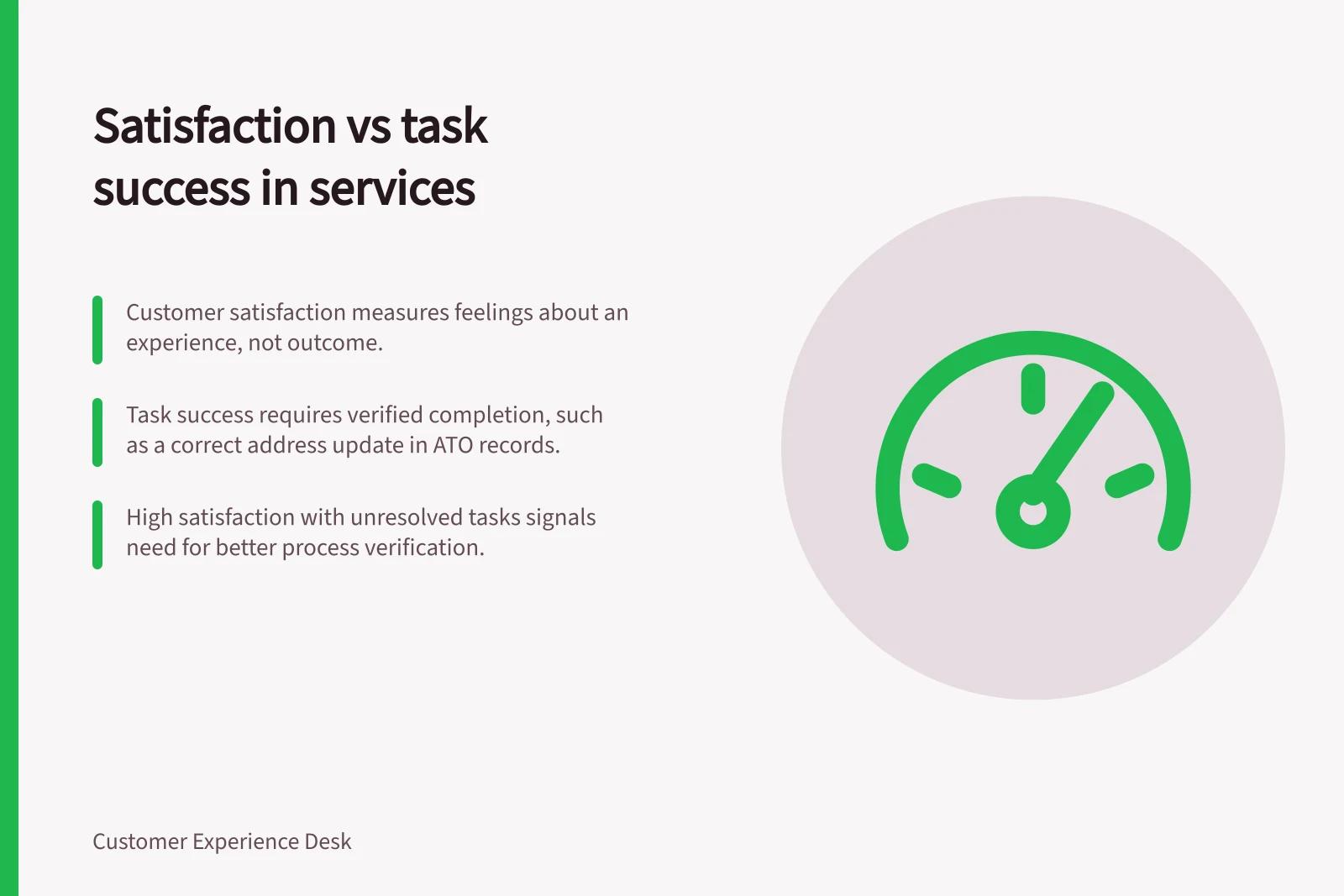
Customer satisfaction describes how someone felt about an experience. Task success describes whether a defined goal was achieved, to the extent that result can be checked. A pleasant interaction can leave a problem unresolved, while a completed task can still be frustrating.
Define the outcomes separately
For an address change, a satisfaction question could ask about the experience of using the service. A success check would ask whether the correct address was updated for the intended purpose. Whether the customer could tell that it happened is another useful observation.
Set the success condition before collecting results. Submitting a form may be too early if an employee must approve the change. Receiving a confirmation may also be insufficient if the record remains wrong. The appropriate endpoint depends on the service task.
In an observed usability session, record whether the participant finished unaided, finished after help, partly completed the task or could not complete it. Note errors and uncertainty. Observed interface completion does not automatically verify a later operational outcome.
Key Metrics for Task Success Assessment
- Success Condition
- Verified outcome (e.g., correct address updated)
- Unaided Completion
- Participant finished without help
- Completed After Help
- Participant needed assistance to finish
- Partially Completed
- Task not fully finished
- Could Not Complete
- Task failed entirely
Ask about the experience assessed
Ask a satisfaction question after the respondent has used the part of the service being assessed. Specify whether the question concerns a form, a support interaction or the complete request. Keep wording and response options consistent when comparing answers over time.
Report who was invited and who responded. Customers who leave before submission may never receive a post-completion survey. A high score among respondents therefore cannot be presented as the view of everyone who attempted the task. Likewise, completion counts from a small qualitative test are not population success rates.
Investigate disagreement
| Satisfaction | Checked task result | Useful question |
|---|---|---|
| High | Success | Was the route still harder than necessary? |
| High | Failure or unknown | Did a reassuring interaction leave the task unresolved? |
| Low | Success | Which delays or repeated steps made completion frustrating? |
| Low | Failure | What blocked the task, and what recovery was available? |
These are prompts for investigation, not study findings. Review the relevant case or observed task before assigning a cause. Interface usability research treats satisfaction and performance as related but distinct measures.
Report both with their limits
For a defined task and period, show the satisfaction question and response count alongside checked success, failure, partial and unknown outcomes. Keep the customer group and timing visible. Do not silently discard cases whose result cannot be verified.
If satisfaction improves while confirmed completion does not, investigate what changed and whether the task remains unresolved. If completion improves while satisfaction falls, examine the work customers had to do. The two measures point to questions; neither explains the cause alone.