Voice of Customer
Part of Customer experience research
Choosing a customer experience question worth investigating
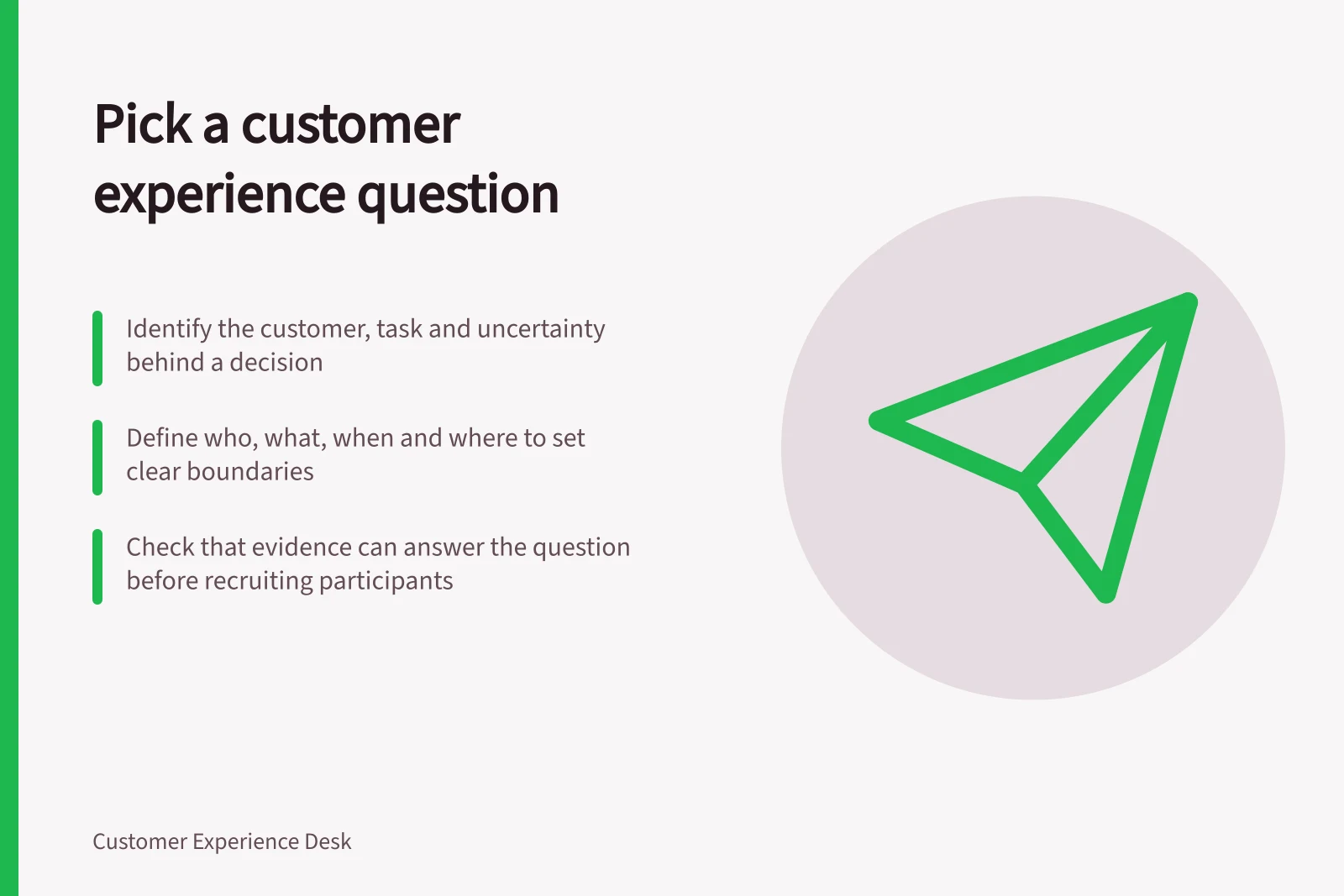
Turn a broad CX concern into a research question with a defined customer, task, uncertainty and decision.
Choose a customer experience research question by starting with a decision someone can make. Name the customer, task and uncertainty behind it. The question should be narrow enough to investigate while leaving room for an unexpected answer.
Work backwards from the decision
Suppose a team wants to understand repeat contacts after an online address change. “Do customers like our website?” offers little direction. “What prompts customers to contact us after submitting an address change?” identifies an experience to investigate without assuming a cause.
Ask the decision owner what could change. Could the team alter the form, confirmation, processing step or support response? If no plausible finding could inform a decision, refine the question or identify the decision still to be made.
Keep the preferred explanation out of the wording. Asking why a confusing confirmation causes calls assumes the confirmation is at fault. Customers might contact support because the change did not take effect, the timing was unclear or something else happened.
Set the boundaries
A useful question identifies:
- Who:the customers or prospective customers whose experience matters.
- What:the task or event under investigation.
- When and where:the relevant stage, channel or period, if these affect the answer.
- Decision:what the organisation could decide after learning more.
For the hypothetical address-change case, the question could ask what prompted follow-up contact among customers who recently attempted the online change. The team can then decide whether to revise the online step or the follow-up process.
Do not define the group so narrowly that it excludes the experience at issue. If abandonment is the concern, completed transactions alone are an unsuitable starting set. Record groups the team cannot reach and how that limits the answer.
Checklist: Is your CX research question ready?
- Clear customer groupE.g., recent users of an online government service in Victoria.
- Specific task or eventE.g., completing an online address change through a state digital service.
- Actionable decisionE.g., revise the confirmation message or improve post-submission support.
Check that evidence could answer it
Interviews about specific incidents can explore remembered experiences. Observation can show whether people find and complete a task in a test setting. Estimating the proportion affected requires a defined population and suitable quantitative evidence or records. Some decisions need more than one method.
Before recruiting, note what each proposed source could show and what it could not. Support records might identify repeat enquiries but cannot reveal every action a customer took before calling. Choose methods after framing the question.
Read the question once more: can someone identify the customer, task, uncertainty and decision? If it still invites several unrelated studies, narrow it to the decision that matters now.
Pros and cons of different research methods for CX questions
- Pros of interviews
- Reveal personal motivations and remembered experiences; useful for understanding 'why'.
- Cons of interviews
- May miss patterns across large groups; prone to recall bias.
- Pros of observation
- Shows real-time behaviour during task completion; identifies usability issues.
- Cons of observation
- Limited to controlled environments; may not reflect real-world conditions.
- Pros of quantitative data
- Measures frequency and scale of issues; supports statistical conclusions.
- Cons of quantitative data
- Cannot explain 'why' behind behaviours; relies on accurate records.