Voice of Customer
Part of Voice-of-customer programmes
Choosing feedback channels for different customer moments
Match page comments, transaction questions, follow-ups and service records to the customer moment each can assess.
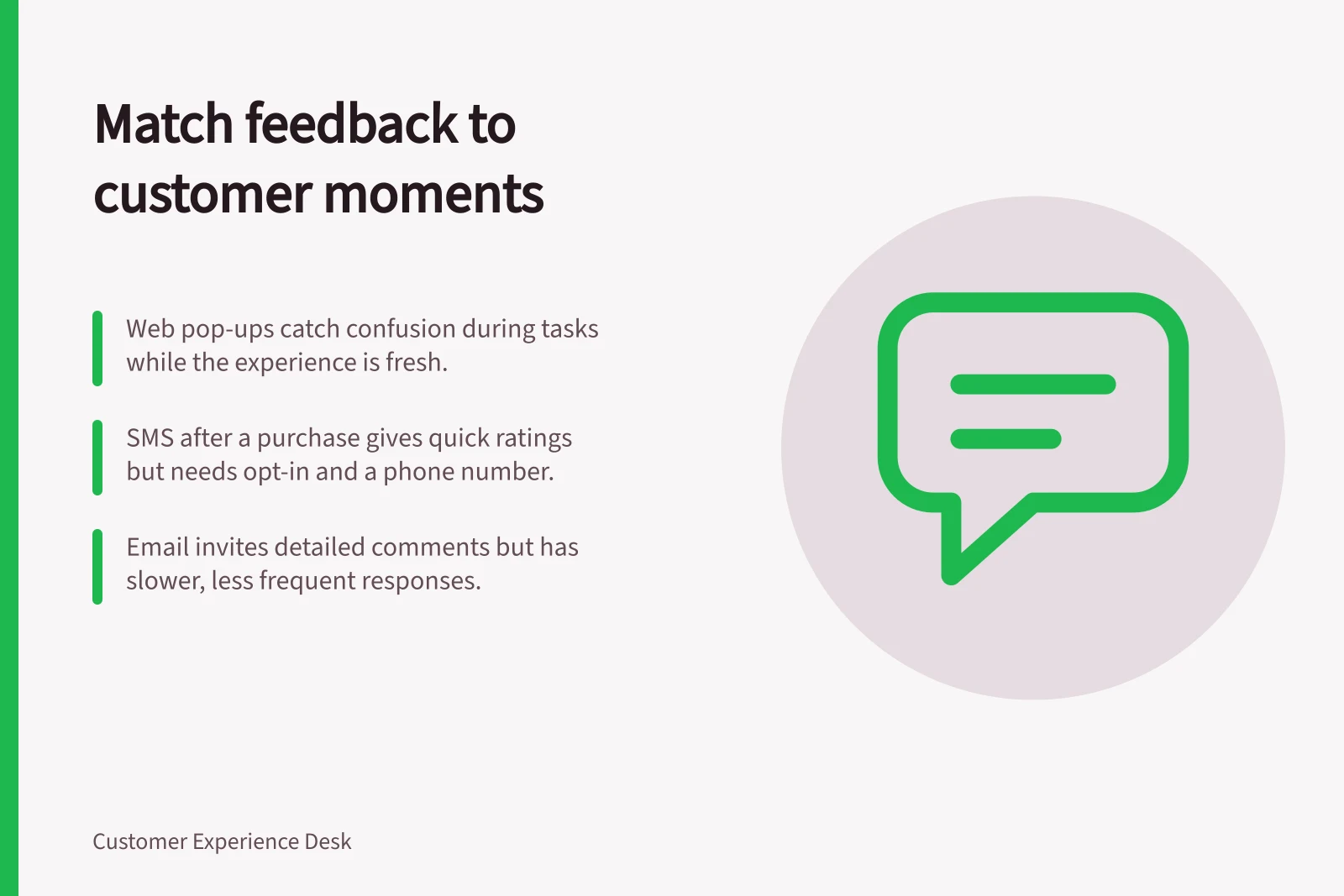
Match the channel to the moment and the evidence you need: a web pop-up can catch confusion during a task, while an SMS or email after an interaction can capture a fresh account of what happened. Each route reaches only people who can access it and choose to respond, so its replies do not describe everyone who attempted the task.
Match the route to what it can reveal
While someone is reading a help page or struggling with an online step, an optional page comment or web pop-up can reveal what is unclear before submission. It reaches people who can still use that page, but misses those who leave before the invitation or cannot find or use it; web pop-ups suit transactional feedback, not relationship NPS.
After a live chat or email interaction, a short survey in the channel used can assess how that interaction worked while it is fresh. It misses people who do not respond and cannot show whether a later service outcome occurred.
After a purchase, delivery or support ticket resolution, SMS can request a quick rating or short comment while the experience is fresh. It can provide a fast signal, but depends on having a phone number and clear opt-in; it misses people without either, can feel intrusive and may cost more than other options.
When a longer account would be useful, email can invite more detailed comments. It reaches customers whose email is deliverable and whose inbox they check, but responses can be slower and less frequent than with SMS.
When feedback arrives as a social-media post or online review, it can reveal complaints or other feedback that customers choose to make public. It misses private views and cannot show how common an issue is among all customers.
During support, a case record and the customer's account can capture a concrete issue for attention, including in face-to-face, phone or online contact. That view can help with the individual issue but cannot show how often it affects all customers.
For an address change, a page prompt can ask what is unclear while the step is fresh; a later email or SMS can ask whether the new address appears where the customer expects it. If processing takes time, an immediate question about success invites a guess.
Feedback channels by customer moment and insight type
- Customer Moment
- During a task (e.g. reading help page)
- Best Channel
- Web pop-up or optional page comment
- Insight Type
- What is unclear in real time
- Limitations
- Misses those who leave before seeing it; not suitable for relationship NPS
- Customer Moment
- After live chat or email interaction
- Best Channel
- Short survey in the same channel used
- Insight Type
- How the interaction worked while fresh
- Limitations
- Misses non-responders; cannot track later service outcomes
- Customer Moment
- After purchase, delivery or support resolution
- Best Channel
- SMS (quick rating/comment)
- Insight Type
- Immediate experience feedback
- Limitations
- Requires phone number & opt-in; may feel intrusive; higher cost
- Customer Moment
- When detailed account needed
- Best Channel
- Email (for detailed comments)
- Insight Type
- In-depth feedback on experience
- Limitations
- Slower response; lower frequency; depends on inbox access
- Customer Moment
- Public complaints or praise
- Best Channel
- Social media or online reviews
- Insight Type
- Unprompted public sentiment
- Limitations
- Misses private feedback; no indication of prevalence across users
- Customer Moment
- Support case resolution
- Best Channel
- Case record or customer account data
- Insight Type
- Concrete issue for individual resolution
- Limitations
- Cannot show how common the issue is across all customers
Check who each channel reaches
Record who could see an invitation, who responded, the task stage and the question shown. A survey sent only after a completed transaction excludes people who abandoned it; support feedback may overrepresent people who needed help.
Email reach depends on deliverability and whether the customer checks that inbox; responses can be slower and less frequent, but may provide more detail. SMS depends on having a phone number and clear opt-in, and may feel intrusive to some customers.
An open comment box may attract particularly motivated people. Their responses can point to problems without measuring how common those problems are among all customers.
Channel reach and response considerations
- Email reach depends on
- Deliverability and inbox checking
- SMS reach requires
- Phone number + clear opt-in
- Open comment boxes attract
- Highly motivated users
- Survey after transaction excludes
- Abandoners of the task
- Support feedback may overrepresent
- Customers needing help
Make the route usable
Keep an optional page comment or web pop-up close to the step it concerns. If someone needs an individual answer, direct them to the service route described in the article on omnichannel service delivery.
If a form collects anonymous comments, explain that a reply is not available there and show where to get help. A time-sensitive account problem should reach a monitored service route.
Check that people can find the route before finishing a failed task, understand whether a reply is expected and provide enough context to be helped without unnecessary personal details. Add a channel when it reveals a part of the experience existing routes miss.
Making feedback routes usable
- Keep web pop-ups close to the relevant stepYes
- Direct users needing help to omnichannel service routeYes
- Explain that anonymous comments won’t get repliesYes
- Ensure time-sensitive issues reach monitored service routesYes
- Confirm users can find the route before failing a taskYes
- Clarify whether a reply is expectedYes
- Provide enough context without asking unnecessary personal detailsYes
- Add a new channel only if it reveals missing insightsYes