CX Measurement
Customer experience measurement
Measure a defined customer task with checked outcomes and relevant feedback, while showing who each result represents.
Start with the customer task and the decision the measurement must inform. Define the result the customer needs, then choose evidence for both that result and the experience of reaching it. A satisfaction score describes respondents' views; it does not confirm that their requests were completed.
Define the task and outcome
Name the customer group, where the task begins and ends, and what counts as success. For an illustrative address change, submitting a form, processing the request and seeing the correct address are different events. Choose the relevant endpoint before collecting figures.
Plan for unsuccessful attempts and unknown results. A survey offered only after submission misses people who left the form earlier. A closed service record may not show whether the customer received or understood the result. Record those gaps instead of treating them as successes.
Key Steps in Measuring Customer Experience
- Define the customer group and task endpointName who is involved and where the task begins and ends—e.g., submitting an address change form to seeing the updated record.
- Identify success criteriaDetermine what counts as completion—e.g., correct address reflected in system after processing.
- Plan for failures and unknownsRecord incomplete submissions or unconfirmed outcomes instead of assuming success.
- Choose appropriate evidence sourcesUse authorised service records for outcome verification; keep experience feedback separate.
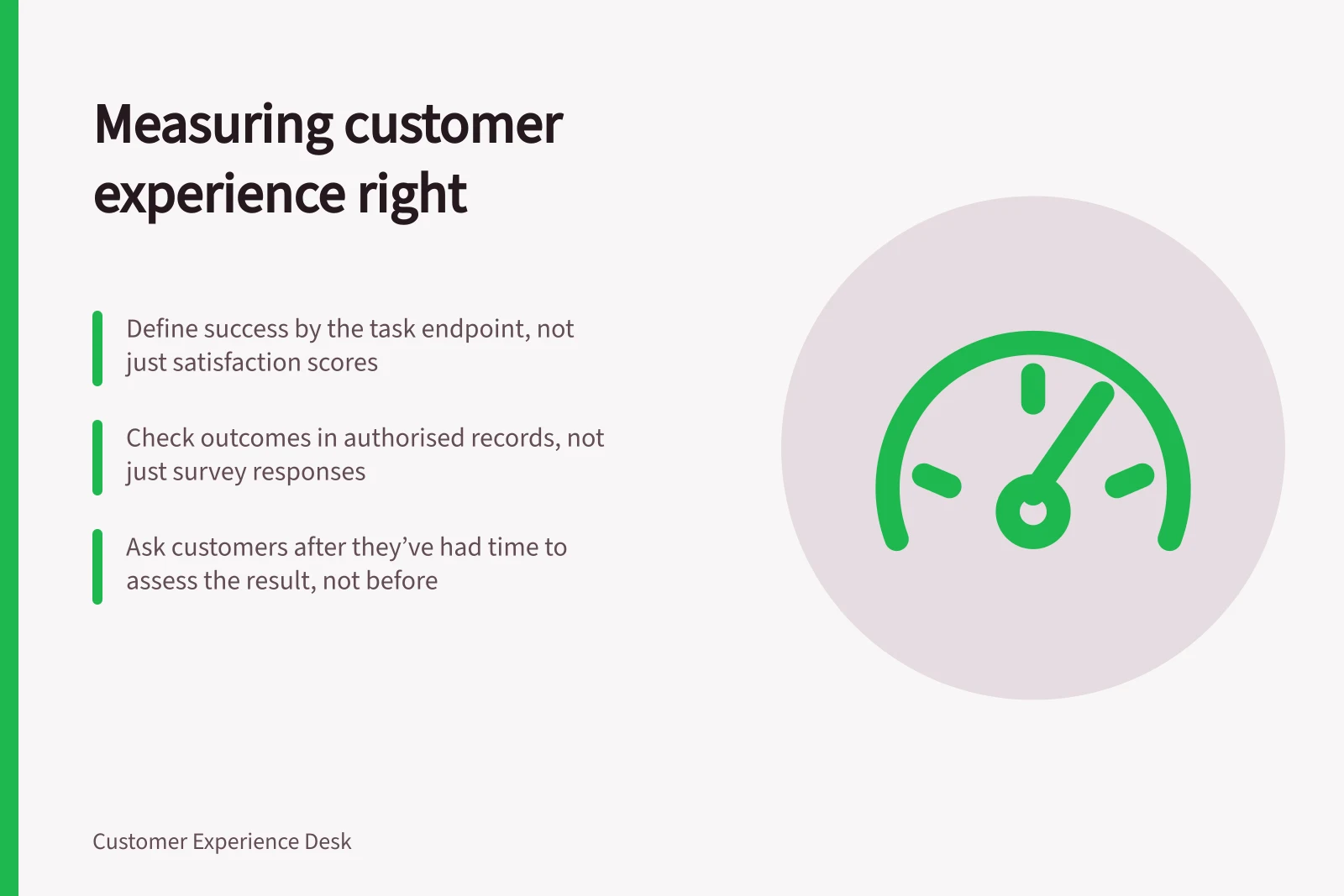
- Align survey timing with customer capabilityAsk about experience only after sufficient time has passed to assess results (e.g., post-change visibility).
Choose evidence for each question
| Question | Possible evidence | Limit |
|---|---|---|
| Did the intended result occur? | An outcome checked in an appropriate service record | The record may not show how the customer experienced it. |
| How did the interaction feel? | Satisfaction with a named step or service | A rating does not verify a later result. |
| How much work did it take? | Reported ease or difficulty, alongside repeated steps or contacts | An easy interaction can still end with a wrong answer. |
| Would respondents recommend the named organisation, product or service? | A recommendation question | The answer does not establish actual referrals or identify a cause. |
Use the smallest useful set of measures. They need not all appear in one survey. Check outcomes in authorised records where possible, and keep reported experience separate from the checked result.
Evidence for Customer Experience Questions vs. Limitations
- Question
- Did the intended result occur?
- Possible evidence
- An outcome checked in an appropriate service record
- Limit
- The record may not show how the customer experienced it.
- Question
- How did the interaction feel?
- Possible evidence
- Satisfaction with a named step or service
- Limit
- A rating does not verify a later result.
- Question
- How much work did it take?
- Possible evidence
- Reported ease or difficulty, alongside repeated steps or contacts
- Limit
- An easy interaction can still end with a wrong answer.
- Question
- Would respondents recommend the named organisation, product or service?
- Possible evidence
- A recommendation question
- Limit
- The answer does not establish actual referrals or identify a cause.
Ask when the customer can answer
A customer can assess a support conversation after it ends. They can assess whether a delayed change took effect only after they have had a reasonable chance to see it. An immediate question about submission may be useful, but a question about unfinished processing asks for a prediction.
Record the invitation event and any delay. Name the experience in the question so a customer with several recent contacts knows which one is meant. Longer delays may make details harder to recall; the right interval depends on the service and the question.
Pros and Cons of Common CX Metrics
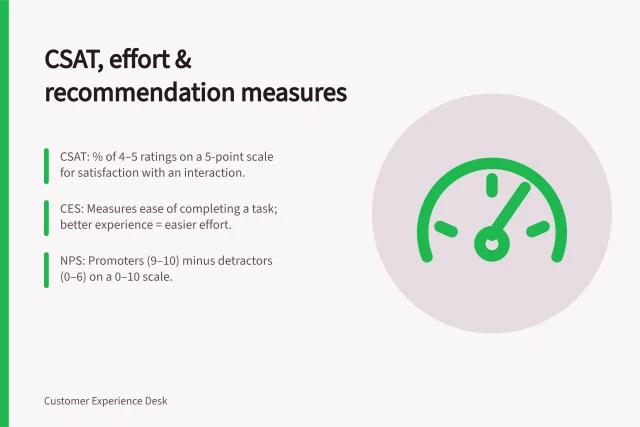
- Net Promoter Score (NPS)Pro: Simple, widely used benchmark. Con: Does not confirm actual referrals or causation.
- CSAT (Customer Satisfaction Score)Pro: Direct measure of satisfaction with specific interactions. Con: Doesn’t verify if request was completed.
- CES (Customer Effort Score)Pro: Reflects how easy the process felt. Con: Easy effort doesn’t guarantee correct outcome.
- Feedback from open boxesPro: Reveals issues not captured elsewhere. Con: Not representative of overall customer base.
Show who the figures represent
For each measure, record who was eligible, who could receive the invitation and who answered. A support survey describes respondents reached through that support route. An open feedback box can reveal an issue to investigate, but its comments do not establish how common the issue is among all customers.
Show response counts, eligible volume where known, checked outcomes and unknown outcomes together. If records cannot connect an interaction to the final result, say so. No further contact is not proof of resolution.
Specify the required output
For example, state which outcome or experience items the team must be able to report together. The Australian Bureau of Statistics recommends starting questionnaire design with the collection objectives and required output; when defining collection objectives, it also identifies who is to be surveyed and the desired output. Keep the collection scope and intended output alongside the task definition so the data items are appropriate and can be collected accurately.
Consider how responses will be coded and processed before collection begins. The Australian Bureau of Statistics advises considering the coding of questionnaire responses and the processing system early, so the information collected can be handled in a way that supports the required output.
End-to-End Process for Valid Customer Experience Measurement
- Define the task and success outcomeE.g., successful address update in ATO records.
- Determine data sourcesCheck service records for outcome; use survey for experience.
- Time the survey invitation appropriatelyAfter a reasonable delay to allow result visibility.
- Record all relevant metricsEligible customers, invitations sent, responses received, outcomes checked.
- Report with full contextInclude period, method, sample size, and any gaps in data.
Check questionnaire quality
Review question wording, question types and questionnaire structure against the information needed. A question that is unclear or poorly placed can produce responses that do not support the intended output, even when the chosen measure sounds relevant.
Before adding a new survey, check whether timely, relevant existing data can answer the question. The American Association for Public Opinion Research notes that surveys are not always the best tool and that administrative records may be needed alongside survey data.
Customer Experience Measurement Best Practices Summary
- Start with collection objectives
- As recommended by the Australian Bureau of Statistics.
- Review question wording early
- Ensure clarity and relevance to avoid invalid responses.
- Consider existing data first
- Administrative records may reduce need for surveys.
- Code responses before collection
- To support accurate processing and reporting.
- Track eligibility and response rates
- Show who was invited, who responded, and why some didn’t.
Keep comparisons interpretable
Retain the question, answer options, invitation point, eligible group, period and calculation with each result. When any of these changes, mark the break before interpreting a score movement. Review relevant comments and cases to investigate possible causes; comments alone do not establish them.
Agree what finding the team will review, who can act and which customer outcome will be checked afterwards. For the illustrative address change, lower post-submission satisfaction could prompt a review of confirmation wording. More repeat contacts could prompt a check of processing or status updates. Neither pattern proves its cause.
A useful measurement record states the finding, its sample limit, the next check and the decision owner.
In this guide
- Comparing CSAT, effort and recommendation measuresCompare what CSAT, customer effort and recommendation questions ask, how common scores are calculated and what each can inform.
- Choosing a survey moment that matches the questionChoose a customer survey moment by what the person can know then, and record the people each invitation trigger misses.
- Reporting customer feedback with sample limitationsReport feedback scores with response counts, coverage, nonresponse and method changes so readers know what the figures support.