CX Measurement
Part of Customer experience measurement
Comparing CSAT, effort and recommendation measures
Compare what CSAT, customer effort and recommendation questions ask, how common scores are calculated and what each can inform.
Choose a measure by the question you need answered. CSAT asks how satisfied respondents were with a named experience. An effort question asks how easy or difficult a task felt. A recommendation question asks how likely respondents are to recommend the named organisation, product or service. None of these answers alone verifies the customer’s result.
Compare the measures
| Measure | Example question | Useful for | Limit |
|---|---|---|---|
| Customer satisfaction (CSAT) | How satisfied were you with the support you received today? | Assessing respondents’ view of that interaction | A favourable rating does not verify resolution. |
| Customer effort (CES) | How easy or difficult was it to complete your return request? | Finding tasks that respondents experienced as difficult | An easy interaction can still produce an incorrect result. |
| Recommendation or NPS | How likely are you to recommend this service to a friend or colleague? | Assessing stated willingness to recommend that service | The answer does not establish actual referrals or identify the cause of a rating. |
Wording and subject shape the judgement. “Support today”, “the return request” and “this service” are not interchangeable. Do not compare their scores as if they share one scale or respondent group.
State the calculation
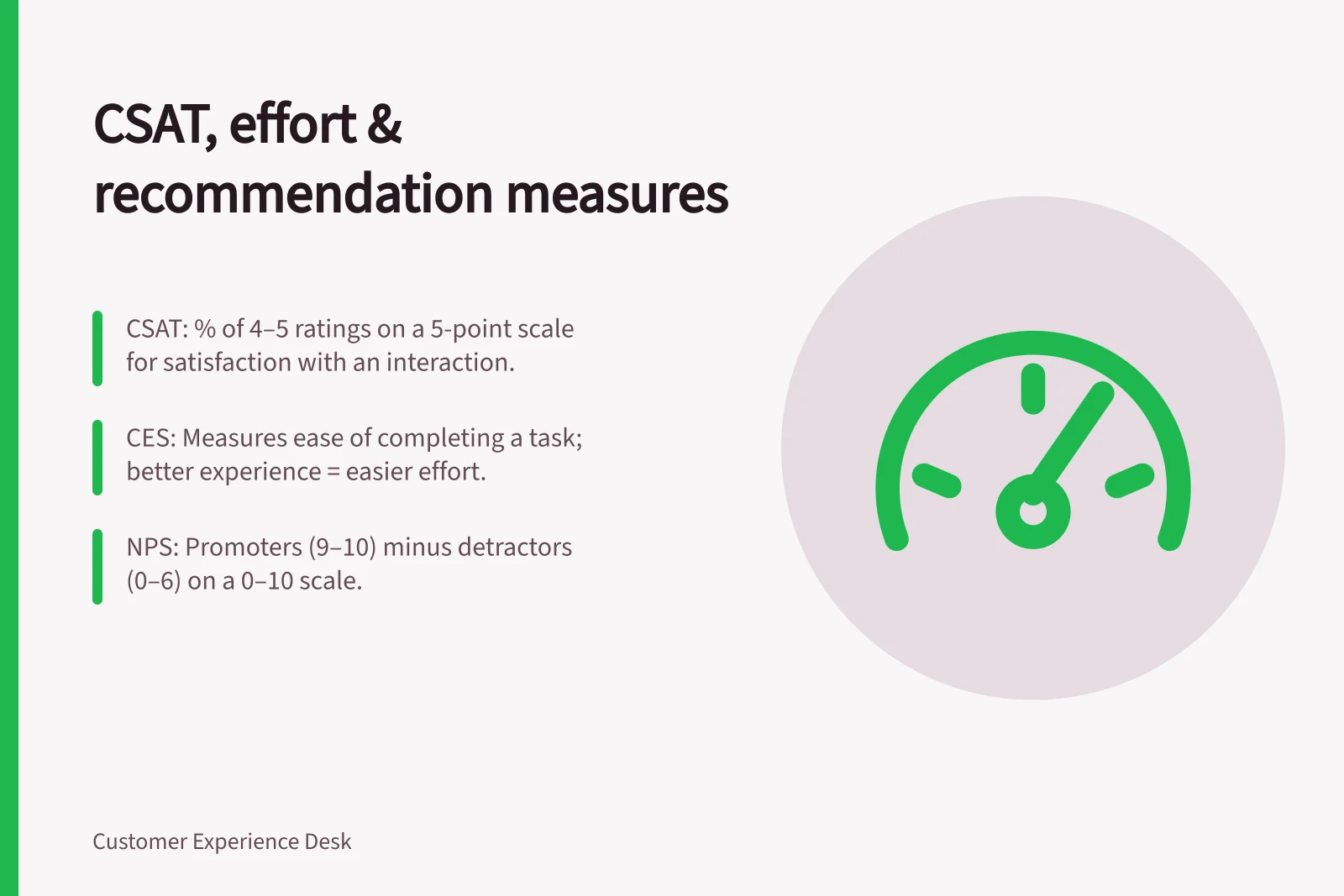
A common CSAT calculation on a five-point satisfaction scale is the percentage of valid responses in categories 4 and 5, where those categories mean “satisfied” and “very satisfied”. State the included categories and denominator. If the report instead uses an average rating, label it as an average.
Effort questions vary in wording and scale direction. One may run from very difficult to very easy; another asks how much effort the customer expended.
State which responses indicate a better experience and whether the result is an average, a distribution or a share who found the task easy. There is no single calculation to assume for every effort question.
Net Promoter Score uses a zero-to-ten recommendation scale. Ratings of 9–10 are promoters, 7–8 passives and 0–6 detractors. NPS equals the percentage of promoters minus the percentage of detractors.
It is a score based on stated likelihood, not the percentage who actually recommended the service. A different scale or calculation should be named separately.
Key Calculation Details for CX Measures
- CSAT CalculationPercentage of valid responses in categories 4 and 5 on a 5-point scale (satisfied, very satisfied)
- CES InterpretationState which responses indicate ease (e.g., 'very easy' to 'easy') and whether result is average, distribution or share who found task easy
Match the measure to the decision
For an illustrative returns team asking whether a revised form feels easier to use, an effort question about completing the return request fits. Check relevant outcomes too, such as whether requests were completed and whether customers had to repeat details. A general recommendation score is too broad to diagnose that form.
To assess a support conversation, ask about it soon after it ends. To assess whether a return was accepted or refunded, check the later result through an appropriate record or follow-up. A customer may value a helpful agent while the return remains unresolved.
A recommendation question can inform a decision about the named organisation, product or service, provided respondents have enough experience to judge it. A movement in its score cannot by itself attribute an effect to one form, agent or policy.
Keep the conditions with the score
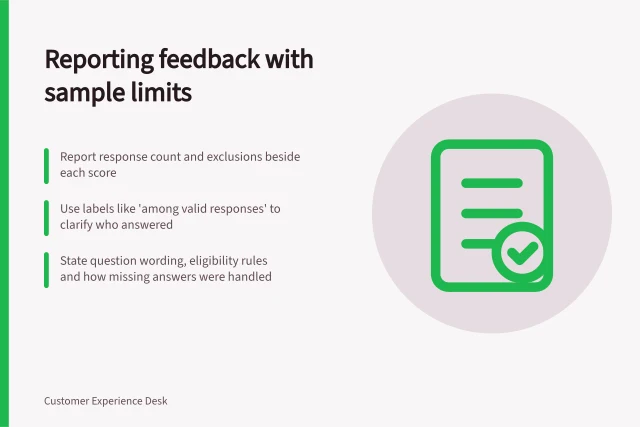
Report the exact question, answer options, invitation point, eligible group, valid response count and calculation. Keep these conditions as comparable as possible across periods. If a score changes, check whether the customer experience, the invited group or the collection method changed before assigning a cause.