CX Measurement
Part of Customer experience measurement
Choosing a survey moment that matches the question
Choose a customer survey moment by what the person can know then, and record the people each invitation trigger misses.
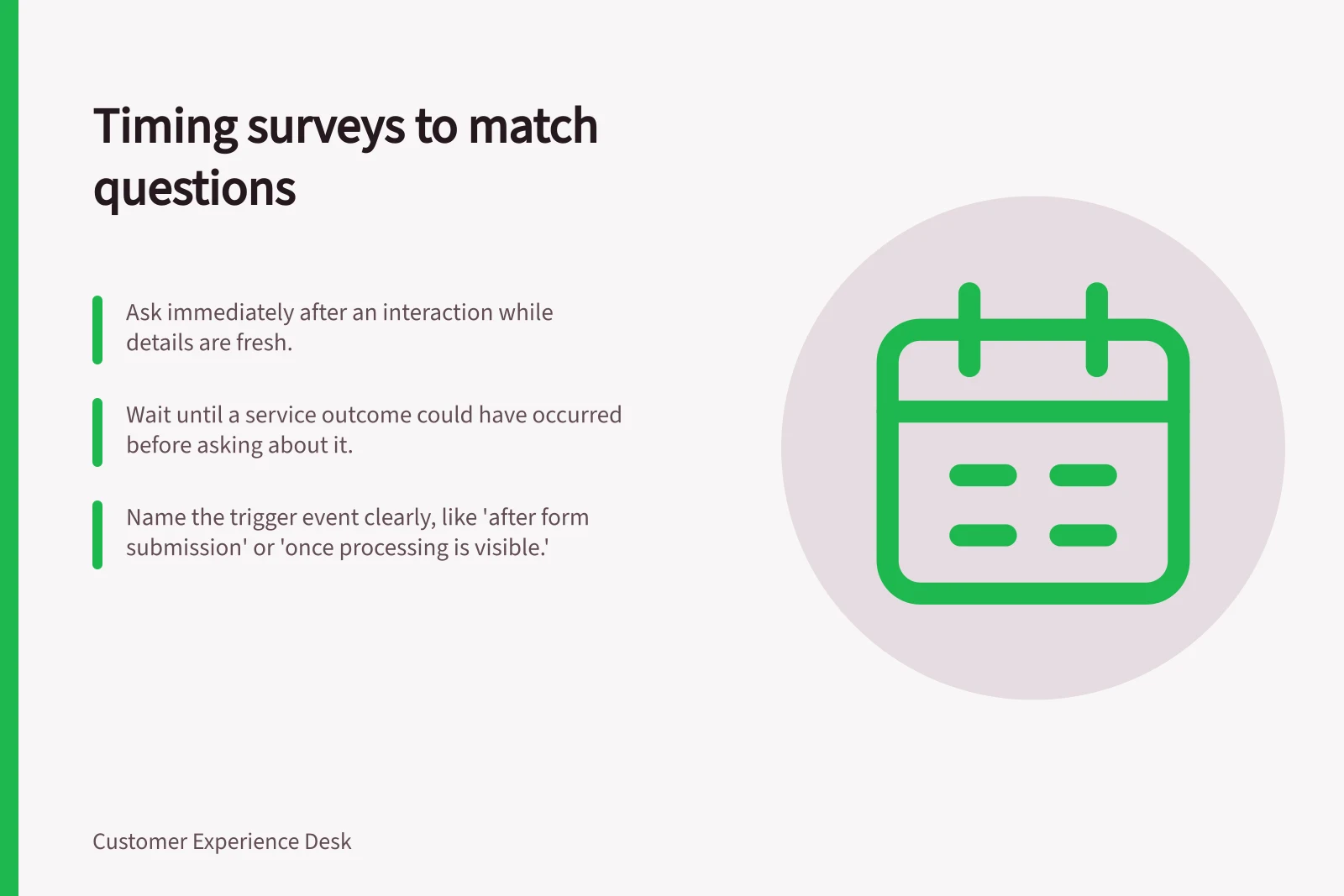
Ask when the customer can reasonably answer the specific question. Immediately after an interaction, they can describe it while it is fresh.
Ask about a service result only after the result could have occurred. Write the question first, then choose the invitation event.
Match the question to an event
For an illustrative address-change request, different moments support different questions:
| Moment | Question the customer may be able to answer | Question that may be premature |
|---|---|---|
| While using the form | What is unclear about this step? | Did the address change take effect? |
| After submission | How easy was submitting the request? | Was the later account update correct? |
| Once processing should be visible | Can you see the correct address where you need it? | How did every detail of the earlier screen appear? |
These are possible pairs, not a fixed schedule. An instant update may be assessable sooner; a request requiring a later decision needs more time. The service’s actual sequence determines when an outcome question becomes answerable.
Define the trigger and reference period
Name the event that starts the invitation, such as a completed call, submitted form or visible decision. Record its time and any delay. A delay is useful only if it suits both the outcome being assessed and the customer’s ability to recall the relevant experience.
Identify the event in the question where practical. “Your address-change request” is clearer for someone with several recent contacts than “your recent experience”. Do not ask whether a promised action happened before it could reasonably have been fulfilled.
Consider the burden of the invitation. Keep a question during a task optional and avoid interrupting completion. Ask after the customer has finished the task unless the question concerns a step they have just completed and answering will not disrupt them.
Record who the trigger misses
A post-submission invitation misses people who abandoned the form earlier. A call-ending survey misses people who could not get through. A later email reaches only eligible people with a usable contact route who choose to answer. State these exclusions when interpreting responses.
If abandonment matters to the decision, investigate it through a suitable route before completion or another method. Do not describe completed-transaction respondents as everyone who attempted the task.
A customer contacting support several times about one issue may receive several invitations. Decide whether results count interactions, people or complete tasks. Record and handle duplicate invitations consistently so repeated responses are not mistaken for independent customers.
Key Considerations for Survey Timing and Coverage
- Post-submission survey misses
- Customers who abandoned the form before submission
- Call-ending survey misses
- Customers who could not get through to support
- Email follow-up reaches only
- Eligible customers with a usable contact route who choose to respond
- Duplicate invitations possible for
- Customers contacting support multiple times on one issue
Check the proposed moment before use
Walk through an ordinary case, a delayed case and an unsuccessful attempt. At each proposed invitation point, check whether the customer could answer the question and whether the invitation names the correct event. Include “not yet” or “not sure” when either is a genuine possible answer.
Keep the question, trigger and delay with the results. If one changes, mark the break before comparing periods. Better timing makes an answer easier to interpret; it does not resolve coverage or non-response limits.