CX Measurement
Customer experience prioritisation
Prioritise CX problems by customer consequence, evidence and delivery effort, then check whether the chosen changes helped.
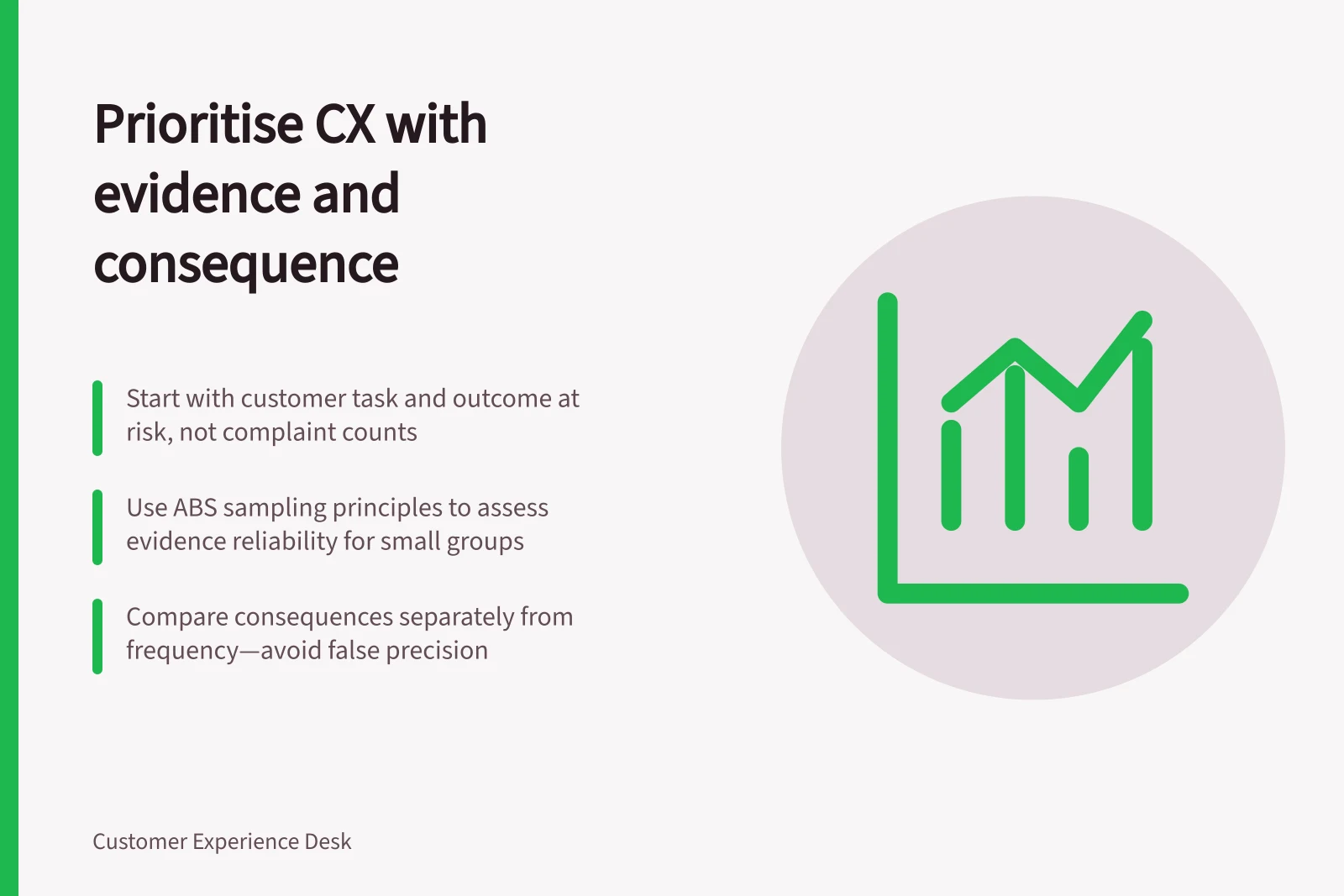
Prioritise customer experience work by the consequence for the customer, the strength of the evidence and the effort needed to make a useful change. Start with the customer’s task and the outcome at risk. Complaint counts and feature requests are signals to examine, not a ranked work plan.
Describe problems before comparing them
Write each candidate as a customer problem: who is affected, what they are trying to do, what happens instead and what consequence follows. “Customers cannot tell whether an address change has taken effect” can be investigated. “Build a status dashboard” is already a proposed solution.
Keep the evidence with the problem. Record whether it comes from observed attempts, customer accounts, service records or feedback, and whom each source could miss. Several comments may reveal a failure without showing how often it occurs. An internal completion flag may show that work moved through a system without showing whether the customer received the result.
Check who the evidence represents
The Australian Bureau of Statistics distinguishes a census, which studies every unit in a population, from a sample, which studies a subset and uses it to estimate the population’s characteristics. A sample needs a robust design and enough units to represent the population reliably; a small sample may not represent the whole population.
When evidence comes from a sample, keep its coverage limits visible as you compare candidates. A census has no sampling error and is more likely to provide detail about small subgroups, but can take longer and cost more; a sample can be quicker and cheaper, but has sampling error and generally provides less subgroup detail.
If the priority of a problem depends on its effect on a small customer group, check whether the available evidence can show that group’s experience. The ABS identifies the level of accuracy required, cost and timing as aspects to consider when designing a sample.
Compare consequences across the work list
For each problem, record what happens when it occurs, who may encounter it, whether the customer can recover and what may happen if the team waits. Keep the limits of each estimate visible. Frequency and seriousness need separate consideration: recurring friction may consume substantial customer time, while a reported failure with a serious consequence may need prompt attention even when its wider frequency is unknown.
Avoid multiplying rough ratings into a precise score that hides those differences. Compare candidates in words, including whose needs the available evidence may overlook. Route a possible urgent risk through the organisation’s appropriate specialist process without waiting for the next prioritisation meeting.
Use severity ratings as shorthand
For usability problems, the Nielsen Norman Group describes a 0–4 severity scale: 0 means the evaluator does not agree there is a problem; 1 is cosmetic; 2 is minor; 3 is major; and 4 is a usability catastrophe. Its guidance ranges from leaving a cosmetic issue unless extra time is available to treating a catastrophe as imperative to fix before release.
Use these labels, if useful, as shorthand for discussing an overall judgement—not as a universal CX rule or a substitute for explaining the customer consequence. The scale was described for usability problems, so its release guidance should not automatically determine the order of every service improvement.
Compare possible responses
One problem may have several responses: help for affected customers, a small change to an instruction, an operational correction or a larger redesign. Estimate effort and dependencies for each response. Ask what it may worsen and how its effect on the customer’s task would be checked.
Ease of delivery does not establish value. Keep customer consequence and implementation effort visible as separate judgements, then explain the trade-off. If the cause or remedy is uncertain, a bounded investigation may be the most useful next step.
Set and revisit the work order
For each candidate, record the problem, evidence and limits, proposed next action, owner and review point. Put work needing immediate attention ahead of lower-consequence items; identify investigations that could change the order; and state what signal would bring a deferred item back. Record why a consequential item was delayed when capacity or dependencies require that choice.
Before approving a change, define what improvement would look like for the complete customer task. After delivery, check the result and any new difficulty elsewhere. A revised form may reduce confusion at submission while requests still fail later. Keep unresolved and unknown outcomes visible when the work order is reviewed.
In this guide
- Comparing customer harm with implementation effortCompare the customer consequence of a service problem with the work involved in each possible fix, without hiding serious failures in a score.
- Separating a frequent annoyance from a serious rare failureSeparate the frequency of a customer problem from its consequence, choose a sound denominator and decide what each finding needs next.
- Building a business case for a service improvementBuild a service-improvement case around a customer problem, baseline, credible options, costs, benefits, risks and a clear decision request.
- Deciding which CX finding needs more evidenceDecide when to investigate a CX finding by identifying the uncertainty that could change the action, then choose a check that answers it.