Service Recovery
Part of Voice-of-customer programmes
Connecting customer feedback with an accountable owner
Route customer feedback to an owner, keep individual cases separate from service issues and check the result of each action.
Connect customer feedback to an owner by recording the issue, assigning the next action and deciding how its result will be checked. A shared inbox can collect comments, but a team must still decide whether someone needs a reply and whether the feedback signals a service problem.
Separate the customer's need from the service signal
A customer who says a replacement has not arrived may need a case owner to check the order and provide an update. Similar reports might warrant investigation by the team responsible for dispatch. These actions can run together, but completing the customer's case should not quietly close the wider investigation.
At intake, ask:
- Does someone need a response?Route a request for help, an answer or a remedy to a team authorised to handle it.
- Is specialist handling needed?Apply the organisation's escalation process to a possible safety issue, serious error or other urgent matter.
- Is there a service signal?Send a possible recurring or consequential failure to an owner who can investigate the underlying step.
- Is essential context missing?Where a reply route exists, ask only for what is needed to take the next action.
Make the assignment actionable
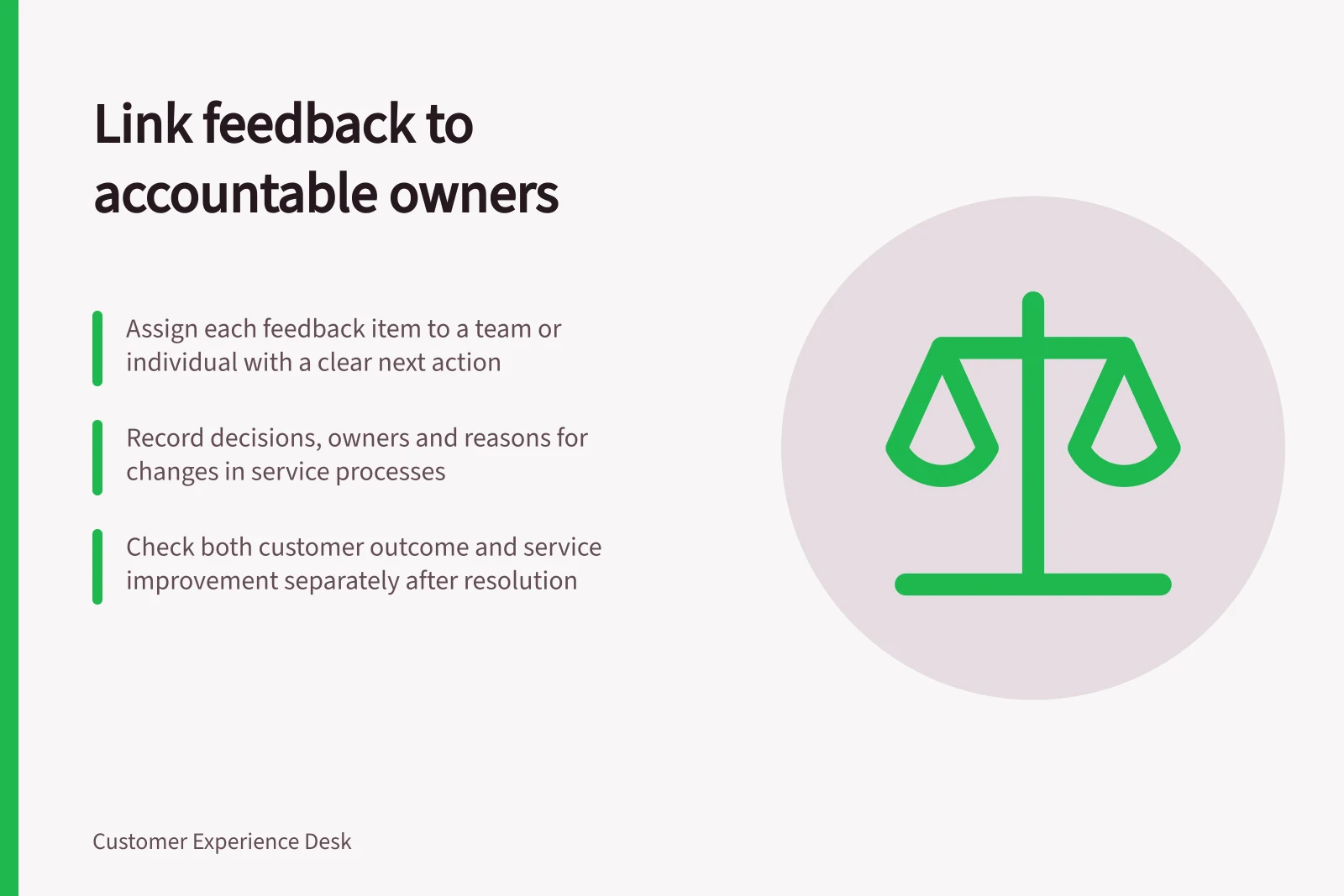
An issue record can state the customer's goal, what they reported, the task stage, available evidence, uncertainty, next action and owner. Record when the next review or customer update is due. A team may own a queue, but each individual case still needs a clear next step and someone responsible for it.
Assign an issue to the team that can investigate or change the relevant service process. A feedback team can maintain the record and prompt review while an operational owner makes or seeks the decision. If ownership is disputed, resolve the assignment internally instead of sending the customer back to the start.
Keep the decision and outcome visible
Record what was decided, who decided it and why. The decision might be to act, gather more evidence, monitor a stated risk or leave the service unchanged. If a change is agreed, name who will deliver it and how the affected customer task will be checked afterwards.
Close the two routes separately. For the individual, check whether the promised answer or action was delivered. For the service issue, check whether the change addressed the reported problem.
A completed ticket alone answers neither question. Tell contactable customers the outcome where appropriate; anonymous contributors cannot be promised an individual reply.
Feedback records may contain personal information. Give owners access only to details needed for their action and follow the organisation's retention process. For entities covered by the Australian Privacy Principles, OAIC guidance requires reasonable steps to protect personal information held.
Key Compliance Requirements
- Privacy Protection (APA)
- Follow OAIC guidelines on security of personal information
- Feedback Ownership
- Only grant access to necessary personal data
- Digital Performance Standard
- Implement monitoring framework for feedback outcomes
- Complaint Handling Best Practice
- Use structured approach from Ombudsman guide