Service Recovery
Service recovery
Diagnose a service failure, choose an appropriate response, check delivery and investigate possible recurring causes.
Service recovery is responding to a service failure with a fair, usable outcome for the customer. Start with what the person needed, what occurred and what remains unresolved. Choose a response that fits those facts, and investigate separately whether the failure could affect others.
Establish the problem before offering a remedy
A customer may say a request was ignored when it reached a team unable to act. Another may have received a prompt reply but still lack the document they needed. Listen to the account, check available records and keep the observed failure separate from an assumed cause.
Record the customer's goal, the failed step, its consequence, the outcome sought and anything already promised. Mark disputed or unknown facts. Give the case an owner who can coordinate the next action, even when another team must investigate. Use the organisation's specialist escalation route where the circumstances require it.
Use customer material to clarify the failure
When the account is unclear, ask for documents that may help explain it, such as a receipt or a photo of a faulty item. Material from the customer can help staff understand the issue, check relevant legal or industry-code obligations, improve processes, train staff consistently and retain evidence for a possible legal action or dispute resolution service.
Make the recovery process usable
A complaint procedure can give staff a consistent basis for handling cases calmly and professionally. Keep it accessible to all staff and easy to understand, so the person coordinating a recovery can use it even when another team needs to act.
Make it easy for customers to complain or give feedback. Many unhappy customers do not complain; they stop using the business. A complaint can be an opportunity to address a problem before it affects more customers.
Match the response to the failure
An appropriate response may include an explanation, an apology, completion of a delayed action, a changed decision or a financial remedy. An apology cannot complete an unprocessed request. Repeating a task may leave a separate loss unaddressed. Some requested outcomes will be unavailable; in those cases, assess the applicable obligations and explain the decision and available options.
For Australian consumer purchases, check the applicable legal obligations and consumer-guarantee rights before deciding on a remedy. The ACCC educates businesses and consumers about their rights and obligations under the consumer guarantees, but it does not provide legal advice about what consumers are entitled to in a particular situation. Other complaints may involve different obligations.
| Question | What to check |
|---|---|
| What does this customer need now? | An available action, explanation or remedy that addresses their particular problem. |
| What has been delivered? | Evidence that a promised action occurred, beyond its approval in a case record. |
| What might happen again? | A possible process or system weakness for an operational owner to investigate. |
A wider investigation need not delay an available remedy for the individual. Resolving the individual case does not establish that the wider issue has been fixed.
Australian Consumer Rights: Remedies for Faulty Goods and Services
- Faulty Product
- Repair, replace, refund, or cancel purchase (ACCC)
- Incomplete Service
- Complete the service or provide a partial refund (ACL)
- Service Not Fit for Purpose
- Refund or replacement if it fails to meet reasonable expectations
- Delay in Delivery
- Re-deliver on time or offer compensation where applicable
Recognise the limits of external reporting
External reporting is separate from resolving the individual case; see the complaint-route article (S042-P08) for external complaint routes and regulator contacts. It does not by itself confirm that a promised outcome was delivered.
Pros and Cons of External Complaint Reporting in Australia
- ProsIndependent review by regulators like the ACCC or state consumer agencies; can lead to systemic changes
- ConsDoes not confirm delivery of promised remedy; may delay individual resolution
Explain the decision and check delivery
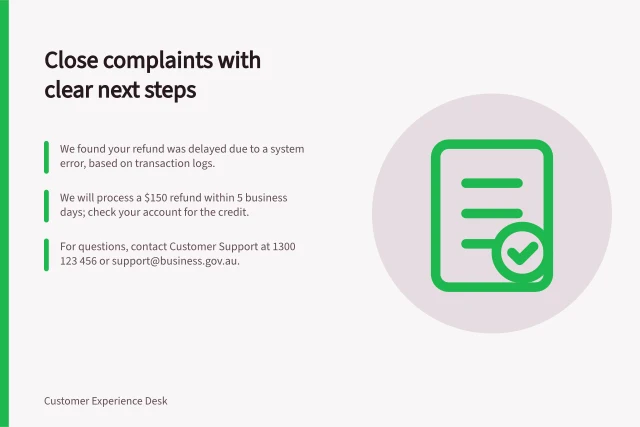
Tell the customer what was found, what remains uncertain, what will happen next and when they can expect an update. If their requested outcome cannot be provided, explain why and give them a usable way to question the decision. Communicate in a form they can access and understand.
Keep promises precise. Approval of a correction and delivery of a corrected invoice are different events. Check the relevant record or delivery step before telling the customer the latter has happened.
A closed ticket, a favourable rating or no further contact does not by itself establish that the promised result was delivered. If an action slips, provide an update rather than waiting for the customer to chase it.
Follow up when the customer can reasonably judge the result. Ask whether the response addressed their need and whether anything remains wrong.
Learn without guessing at a pattern
Record the failed step, response, outcome and any possible recurring cause for the responsible team to review. Compare relevant cases and service records before declaring a shared cause.
A single case can reveal a serious weakness; a rise in complaint counts can also reflect a more visible complaint route. Assign a separate owner to any wider issue and check whether a proposed change was implemented.
Describe a change to affected customers only at its verified stage. Later cases can then show whether people still encounter the reported failure.
External options
Customers may also contact a state or territory consumer protection agency where appropriate.
In this guide
- Choosing a recovery action that addresses the actual failureIdentify the unmet customer outcome, assess its consequences and choose a recovery action that can be delivered and checked.
- Explaining what changed after a repeated service problemTell affected customers what was found, what has changed, what remains uncertain and what they can do if the problem recurs.
- Measuring trust after a resolved complaintDefine resolution, ask about future confidence after the outcome can be judged and report responses with their sample limits.
- Avoiding compensation that leaves the underlying issue untouchedDistinguish an owed remedy from a goodwill offer, then check both the customer response and the original service issue.