Voice of Customer
Part of Voice-of-customer programmes
Writing feedback questions without leading respondents
Write neutral customer feedback questions with one clear subject, balanced options and room for uncertain or different experiences.
Write feedback questions so customers can answer unfavourably, favourably or uncertainly without first correcting an assumption. Name the experience, ask one thing at a time, and offer answers that fit people whose experience differed from the expected path.
Remove the assumed answer
The Australian Bureau of Statistics advises against joining separate concepts together in a question and recommends testing questions with actual respondents. Use these principles to check customer feedback questions:
| Wording to revise | What it assumes | More neutral alternative |
|---|---|---|
| Why was our helpful agent so reassuring? | The agent was helpful and reassuring | How would you describe the help you received from the agent? |
| Did the easy online form save you time? | The form was easy and saved time | How easy or difficult was it to complete the online form? |
| How satisfied are you with your successful address change? | The change succeeded | Has your address been changed? Offer “yes”, “no” and “not sure”, where those answers fit the service. |
Ask the last question after the customer has had a reasonable chance to see the result. Their answer reports what they know; it does not, on its own, verify the account record. If submitting the request matters, ask about that separately.
Neutral vs. Leading Question Examples
- Leading Question
- Why was our helpful agent so reassuring?
- Assumption in Question
- The agent was helpful and reassuring
- Neutral Alternative
- How would you describe the help you received from the agent?
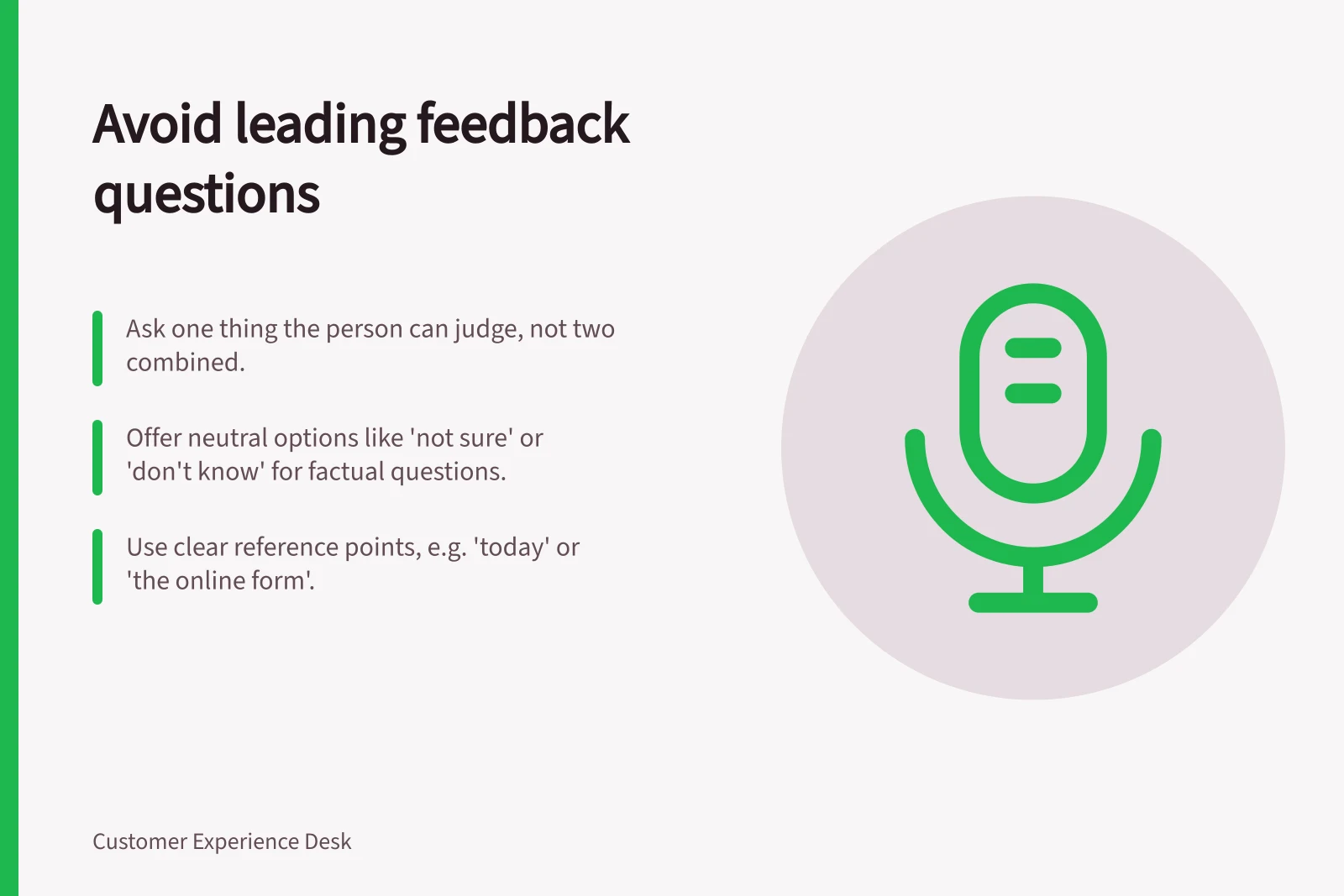
Ask one thing the person can judge
“Was support quick and accurate?” combines two judgements. A customer who received a fast but incorrect answer cannot respond clearly. If time is the subject, ask about time taken; check accuracy through an appropriate case review. Do not ask customers to assess an internal process they could not see.
Specify the reference point. “How was your experience?” could mean a page, a call or the entire request. “How easy or difficult was it to find the return instructions today?” gives a clearer task and moment. Avoid internal terms unless customers understand them.
Combining Judgements vs. Separate Questions
- Combined Judgment
- Was support quick and accurate?
- Issue
- Customers cannot clearly express mixed experiences (e.g., fast but incorrect)
- Recommended Approach
- Ask about time taken separately; assess accuracy through case review
Allow for different experiences
For a rating, balance equivalent ends such as “very difficult” and “very easy”, and include a meaningful middle where appropriate. For a factual question, offer “not applicable” or “don't know” when either is a valid answer. Make response categories distinct.
If someone could not start a task, a scale beginning at “completed with difficulty” gives them no accurate choice.
An open follow-up might ask, “What, if anything, influenced your answer?” It lets someone explain a good or bad experience without suggesting either. Keep the number of questions tied to the decision the team needs to make.
Balanced Response Options for Ratings
- Unbalanced ScaleCompleted with difficulty → Very easy
- IssueNo option for people who couldn’t start the task
- Recommended ScaleVery difficult → Very easy, with 'Not started' or 'Not applicable'
Check the draft question
Read each question with its answer options. Look for praise, blame, a presumed event, two topics joined together, or an experience the options cannot express. Ask people from the intended audience what they think the question means and how they chose an answer. Revise unclear wording before using responses to compare periods or groups.
Keep the wording, options and invitation point with any results. If one changes, a difference in answers may reflect the changed question or invitation rather than a changed service.
Checklist for Reviewing Draft Feedback Questions
- Look for praise or blame in wordingAvoid implying a positive or negative outcome
- Check for assumed eventsEnsure no prior assumption about success or completion
- Verify one topic per questionSplit combined concepts like speed and accuracy
- Test with target audienceConfirm questions are interpreted as intended