Voice of Customer
Customer interviews
Plan useful customer interviews: recruit relevant people, ask about real experiences and report findings with clear limits.
Customer interviews help a team understand how people experienced a task, what they tried and what got in their way. They suit questions about context and reasoning.
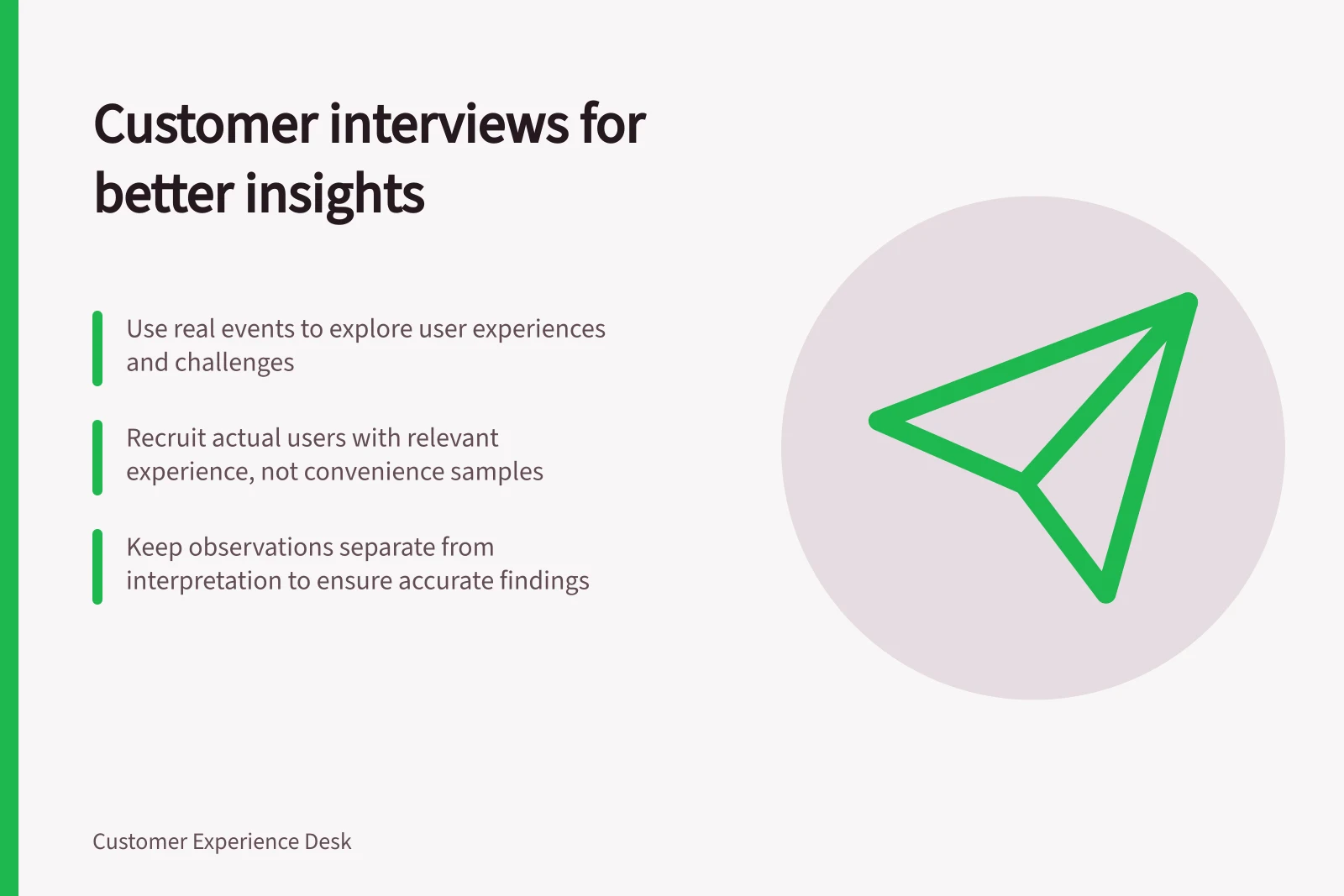
Alone, they cannot prove how common a problem is or whether a proposed interface will work in use. Set a narrow research question, recruit people with relevant experience and keep observations separate from interpretation.
Key Guidelines from Trusted Sources
- Best practice source
- UK Government Service Manual
- Australian customer research guide
- Queensland Business Development – Market & Customer Research
- Expert insights
- The Real Group Australia – Customer Interviews
Decide what you need to learn
Start with a decision the team must make. “Why do recent customers abandon the renewal process?” beats “What do customers think of our brand?” The first names a recent experience, a group to recruit and a route to a product decision. It also helps the interviewer stay curious when an answer is unexpected.
Interviews explore motivations, expectations, workarounds and the sequence of events around a service. People can report their experiences and what they did. Observation is needed to see whether they can complete a specific task in practice, such as in a prototype. For the proportion of all customers affected, use an appropriate quantitative method.
A useful test: does the decision depend on understanding people’s circumstances, work or service use, and the problems they describe? In-depth interviews suit learning about those contexts and exploring problems in more depth. If people carry out a service together, consider whether their shared experience is part of the question.
Recruit for the experience, not convenience
Define the customers whose decisions matter. Recruit actual or likely users with relevant experience, including people with different access needs. Avoid a convenience sample of colleagues or the most enthusiastic customers.
Explain the session purpose, what will be recorded, how notes will be used and how someone can decline. An information sheet can support informed consent.
Collect only the personal detail needed to manage participation, store it securely, and share it only with colleagues who need it. Set a retention plan before collecting notes or recordings. Check local privacy requirements for the organisation and location; do not assume a generic guide applies.
Ask for the story of a real event
When the research question concerns a real event, ask about a recent instance and what happened next. Keep hypothetical feature pitches out of the opening.
Plan the session around the question
In-depth interviews are usually held with one participant at a time. A pair or small group can suit people who use the service together, such as family members who help each other or colleagues who share tasks. Fit the format to how the experience happens, not just convenience.
Allow enough time for the subject and questions: interviews can run from 30 minutes to 2 hours, depending on complexity. Choose a setting that works for the participant, whether their home or workplace, a neutral venue or a phone or video call. Check the venue is accessible and arrange an interpreter or assistant if needed.
Before the session, review the research questions and any process or technology you want to discuss. Put topics in a logical order, prepare starter and follow-up questions, and try the structure with a colleague. Revise anything unclear or awkward.
Turn accounts into findings carefully
After each session, capture the specific incident, relevant context and the participant’s own phrasing where permission allows. Mark direct observation, participant report and researcher interpretation separately. Do not turn “three interviewees described a delay” into “customers always face a delay”. The sample and recruitment route limit what the finding can claim.
Compare accounts across participants to identify candidate themes. Keep any theme traceable to individual accounts, include contrary cases and state its limits.
Close the loop with a decision: investigate the renewal error, change the help text, test a new flow or gather broader evidence. Record what remains uncertain.
In this guide
- Recruiting participants who represent the intended customersRecruit interview participants who have the relevant customer experience, while recording sample gaps and access needs.
- Asking about real experiences instead of hypothetical preferencesAsk customers about recent real events and use neutral follow-ups instead of treating hypothetical preferences as behaviour.
- Recording interview findings without inventing consensusRecord interview observations, participant reports and interpretations separately without overstating consensus.
- Turning interview notes into evidence-backed themesTurn interview notes into traceable themes by coding observations, checking contrary cases and stating sample limits.