
Voice of Customer
Part of Customer interviews
Recruiting participants who represent the intended customers
Recruit interview participants who have the relevant customer experience, while recording sample gaps and access needs.
Recruit interview participants from the customer group your research question concerns. Someone who fits a broad demographic but has never faced the relevant task may be less useful than someone who recently tried it. Define inclusion criteria, seek variation within the group, and record the gaps in your sample.
Translate the question into a screener
Say you want to understand why small-business customers abandon an onboarding step. A useful screener asks whether the person started that step recently, what role they played and whether they completed it. “Do you find onboarding frustrating?” is a leading screen; it selects people already willing to describe the experience in those terms.
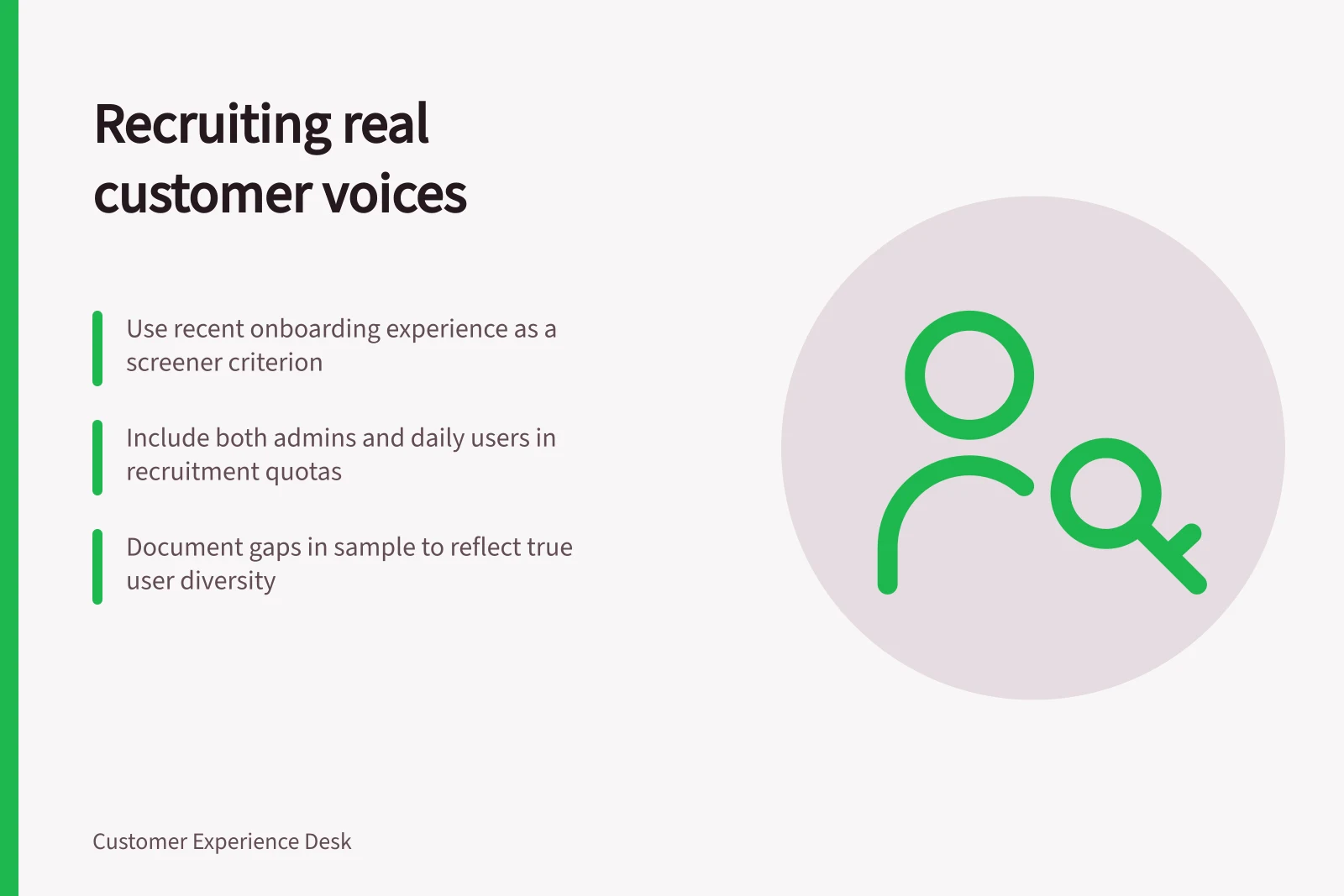
Write criteria before inviting anyone. Include a time window where memory matters, the product or service experience required, and any exclusion that protects the study from an irrelevant perspective. Keep the screener short enough that it does not conduct the interview in advance.
Avoid one-channel samples
Existing customer lists are convenient, but they may exclude people who left before becoming customers or who use a different route to the service. Recruitment through a support team may over-represent people with problems.
An agency or community organisation can reach a different group, though you still need to verify that recruits meet the criteria. GOV.UK's participant guidance recommends actual or likely users and a spread of people, including those with access needs.
Set quotas only where they serve the decision. If both account administrators and day-to-day users handle onboarding, include each role. If one group is harder to recruit, document the shortfall rather than quietly treating the easier group as representative. Qualitative interviews seek useful variation, not a claim that a small sample statistically mirrors the whole customer base.
Make participation possible
Offer session times and formats that do not systematically exclude people with limited availability, connectivity or accessibility needs. Give a clear information sheet covering the topic, time, recording, incentive if any, and how to contact the research team. Ask about access needs without making participants disclose more than required. Tell them how their information will be used and stored.
Keep recruitment details separate from the interview analysis where practical. Share names and contact information only with people who need them to arrange sessions. GOV.UK's privacy guidance recommends minimising collection and controlling access to participant details. For an Australian business, have local privacy processes reviewed against its own obligations; a UK service manual is methodological guidance, not a statement of Australian law.
Document the sample you obtained
Before interpreting findings, record the recruitment source, the criteria each person met and the relevant variation across participants. Note who was invited but did not participate when that affects the sample. If every interview came from highly engaged customers, say so beside the findings. Then recruit a contrasting group if the decision depends on what less engaged people experienced.
The test of recruitment is whether the participants can speak from the experience the study aims to understand. It is also whether the team knows whose experience remains unheard.


